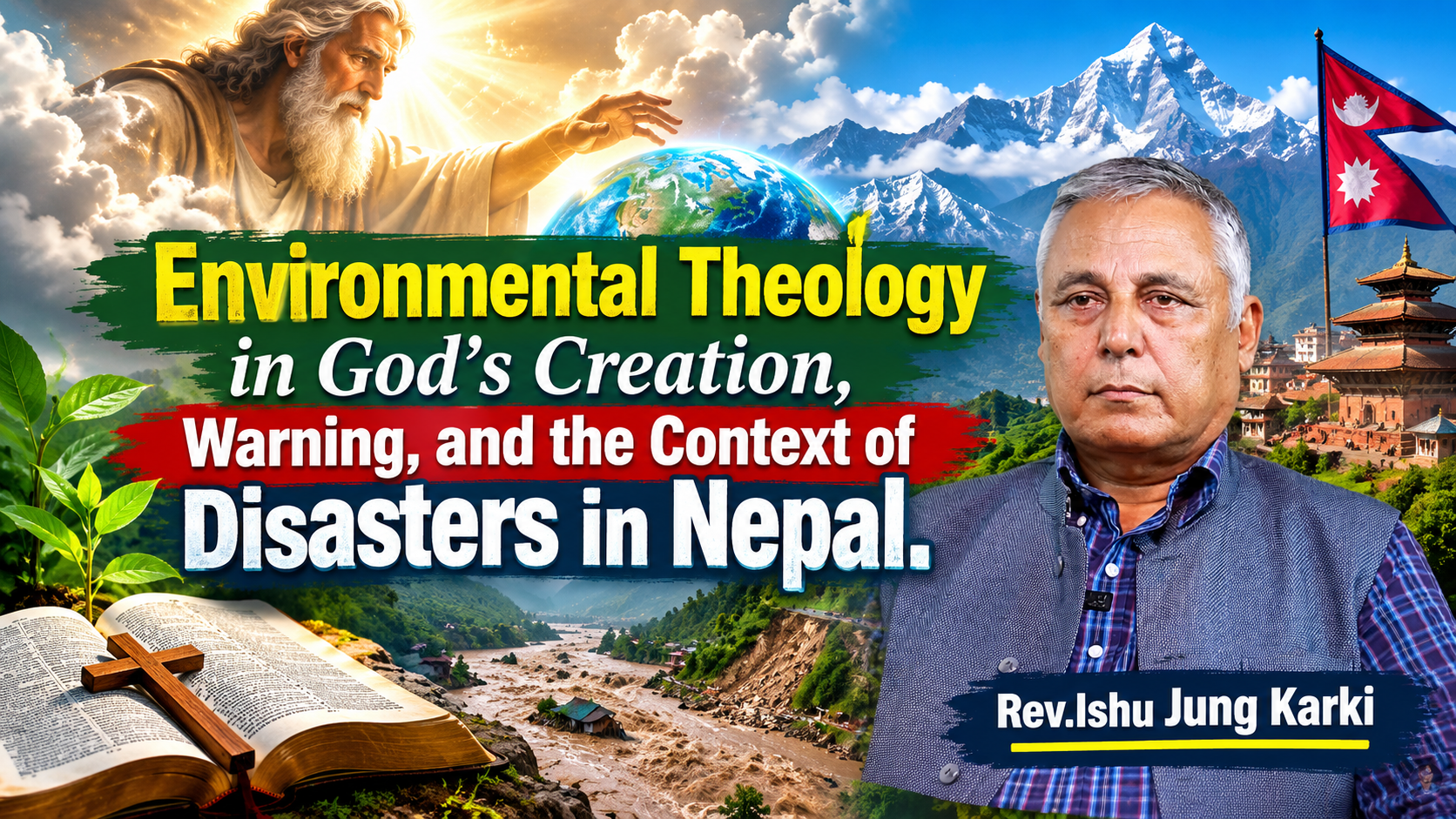
Dr. Isu Jung Karki
Pastor and Christian Leader
Nepal
Abstract
After creating the world, God saw that it was “very good” (Genesis 1:31). Yet today, human society faces growing challenges such as air and water pollution, deforestation, depletion of water resources, climate change, loss of biodiversity, unplanned urbanization, and increasing risks from natural disasters. These challenges are not merely scientific or economic issues; they also have profound ethical, spiritual, and theological dimensions.
The Bible presents the earth as God’s creation and possession and human beings as responsible stewards of it. “The earth is the LORD’s, and all its fullness” (Psalm 24:1). Genesis 1–2, Psalm 104, and Leviticus 25 provide important foundations concerning the value of creation, human responsibility, and the balanced use of land and natural resources. Psalm 104 connects water, vegetation, animals, mountains, seas, and human life within one integrated created order.
Comparing the Kathmandu, Terai, and hill environments of approximately fifty years ago with the present situation reveals the seriousness of environmental change. Today, air pollution, drying water sources, polluted rivers, declining agricultural land, and rapid urbanization have become major concerns. Alongside natural processes, the role of human lifestyles, excessive consumption, deforestation, unsustainable land use, and irresponsible development must also be considered.
It is not biblically appropriate to regard every natural disaster as a direct punishment for personal sin. In Luke 13:1–5 and John 9:1–3, Jesus rejected such simplistic connections between suffering and individual sin. Nevertheless, irresponsible human behavior can increase environmental risks and human vulnerability. Therefore, scientific study of disasters must be accompanied by ethical responsibility.
Biblical warnings and prophecies are not intended to produce fear and despair. Noah prepared after receiving a warning (Hebrews 11:7), Proverbs teaches that a prudent person sees danger and takes precaution (Proverbs 22:3), and Jesus instructed His disciples to “watch” and “stay awake” (Matthew 24:42). From this perspective, the appropriate response to warning is awareness, wisdom, preparedness, responsibility, and hope.
Such responsibility is especially important in Nepal’s Himalayan and mountainous geography. The devastating event in the Rasuwa–Bhotekoshi region on August 26, 2026, once again highlighted the need for attention to Himalayan hazards, safe infrastructure, early-warning systems, and community preparedness. In such circumstances, the ministry of the church should not be limited to disaster relief but should extend to disaster preparedness, environmental conservation, clean water, health, restoration, and the protection of vulnerable communities.
Ultimately, Christian environmental theology brings together creation, human responsibility, the Fall, the groaning of creation, salvation in Christ, and the new creation within one theological framework. Environmental protection is not the worship of creation; rather, it is the responsible care of God’s creation while worshiping the Creator.
Keywords: environmental theology, creation, stewardship, climate change, disaster, Nepal, church, creation care
⸻
- Introduction
In the Christian faith, God is the Creator, and the whole of creation belongs to Him. The declaration of Psalm 24:1—“The earth is the LORD’s, and all its fullness”—establishes God’s ownership before humanity’s rights or claims.
In Genesis 1, God repeatedly declares creation to be “good.” Finally, after looking upon the whole of creation, He declares it to be “very good” (Genesis 1:31). This indicates that the value of creation does not depend solely upon its usefulness to humanity. Creation itself expresses the wisdom, power, and glory of God.
According to Genesis 2:15, humanity was placed in the garden “to work it and take care of it.” Therefore, human beings are not absolute owners of creation; they are responsible stewards of God’s creation.
On this foundation, the present environmental crisis should not be understood merely as a scientific or economic problem. It must also be understood as a moral issue connected to the relationship between God, humanity, and creation.
⸻
- Creation and Environmental Responsibility
Psalm 104 is particularly significant for environmental theology. It presents water, mountains, vegetation, animals, birds, the sea, and human life as interconnected within one created order. Psalm 104:24 states:
“How many are your works, LORD! In wisdom you made them all; the earth is full of your creatures.”
From this perspective, nature is not merely an object for human consumption; it is God’s creation and a witness to His glory.
The regulations concerning the land in Leviticus 25 are also significant. The practice of allowing the land to rest demonstrates the principle that natural resources should not be used merely for continuous production and economic profit without recognizing their capacity for renewal and restoration.
In contemporary language, this can be related to the principle of sustainability—development is necessary, but development should not destroy the long-term existence of land, water, forests, and human life.
⸻
- Environmental Change in Nepal
There is a significant difference between the environment of Kathmandu approximately fifty years ago and the present situation. At that time, fog, frost, stone water spouts, wells, and agricultural land were common features of the landscape. Today, air pollution, dust, polluted rivers and streams, drying water sources, increasing pressure on groundwater, and rapid urbanization have become serious problems.
The decline of agricultural land, the expansion of infrastructure into natural areas, and the growth of highly consumer-oriented lifestyles are weakening the relationship between human beings and nature.
This raises a serious question: In the pursuit of development and prosperity, how much environmental, social, and moral value are we losing?
Religion can play an important role in addressing this question. Religious values such as self-restraint, compassion, responsibility, justice, and respect for nature can contribute to changes in human lifestyles.
⸻
- Sin, Human Behavior, and Environmental Destruction
The Bible does not present human sin merely as an individual spiritual problem; it also reveals its social and creational consequences. Genesis 3:17–19 describes the disorder introduced into the human relationship with the land following the Fall. Hosea 4:1–3 presents a connection between human moral corruption and the suffering of the land.
It would not be appropriate to describe these passages as a direct scientific explanation of modern climate change. Nevertheless, greed, excessive consumption, deforestation, water and air pollution, unplanned urbanization, and unsafe construction can increase environmental risks.
Therefore, the environmental crisis is also a question of human morality.
At the same time, it is inappropriate to interpret every disaster as punishment for personal sin. In Luke 13:1–5, Jesus rejected the assumption that those who died in a disaster were greater sinners than others. Likewise, in John 9:1–3, He did not attribute the condition of the man born blind to a particular sin committed either by the man or his parents.
Therefore, the interpretation of disasters requires both theological discernment and scientific understanding.
⸻
- Warning, Prophecy, and Preparedness
The purpose of biblical warnings and prophecies is not to frighten people or make them passive, but to make them alert and responsible.
Noah prepared after receiving a warning concerning the coming flood. Hebrews 11:7 connects his response with faith and obedience. Proverbs 22:3 teaches that a prudent person sees danger and takes precautions.
Jesus also instructed His disciples concerning difficult times, saying, “Watch” and “Stay awake” (Matthew 24:42; Luke 21:34–36).
An important principle can therefore be drawn:
The proper response to warning is not fear but wise preparedness.
Therefore, concerning climate change, disasters, or future risks, Christian communities should neither create sensational fear nor ignore the issues. It is necessary to understand the facts, respect scientific knowledge, identify risks, make appropriate preparations, and raise awareness within the community.
⸻
- Himalayan Disasters in Nepal and Responsibility
Because of Nepal’s geographical characteristics, the Himalayan and mountainous regions face serious risks from floods, landslides, glacial hazards, and other disasters.
The event in the Rasuwa–Bhotekoshi region on August 26, 2026, once again highlighted the vulnerability of the Himalayan environment. Rapid flows of ice, rock, water, and debris can create significant risks to settlements and infrastructure.
Such events raise questions not only about the study of natural processes but also about settlement patterns, infrastructure safety, early-warning systems, and community preparedness.
Human beings cannot prevent every natural disaster. However, damage can be reduced through risk assessment, safe construction, early-warning systems, evacuation plans, and community preparedness.
Therefore, prayer and preparedness are not opposites.
⸻
- The Positive Role of Religion and the Church
Religion should not be limited to tradition and religious rituals. It can transform human character, lifestyles, and social responsibility.
Values such as cleanliness, compassion, mercy, self-restraint, love, justice, and responsibility toward vulnerable people are closely related to environmental stewardship.
The church can make environmental ministry part of its holistic ministry. Areas of ministry may include clean water, sanitation, waste management, tree planting, protection of water sources, health education, disaster preparedness, and assistance to vulnerable families.
In Jesus’ ministry, teaching, proclamation of the gospel, and healing were closely connected (Matthew 9:35). From this, the church’s healing ministry can be understood more broadly:
Healing → Prevention → Protection → Restoration → Resilience.
A healthy environment contributes to the development of a healthy community.
⸻
- Environmental Justice and Love of Neighbor
The burden of environmental damage is not equally distributed among all people. Poor families, rural communities, settlements along rivers, Himalayan communities, children, older people, and other vulnerable groups may be disproportionately affected.
Therefore, environmental protection is closely connected with social justice.
Jesus commanded, “Love your neighbor as yourself” (Matthew 22:39). If our lifestyles harm the water, air, land, or health of others, environmental responsibility becomes a matter of love for our neighbors.
Thus, environmental theology is not merely a campaign to “save nature”; it is also a ministry of protecting human life, pursuing justice, and expressing love.
⸻
- Practical Priorities for the Church
Local churches can give priority to the following actions in environmental and disaster ministry:
- Biblical teaching on creation care.
- Protection of springs and local water resources.
- Tree planting together with long-term tree protection.
- Waste management and reduction of plastic use.
- Disaster preparedness and volunteer training.
- Cooperation with local early-warning systems.
- Identification and assistance of families at risk.
- Public awareness concerning clean water, health, and sanitation.
- Involvement of young people in environmental ministry.
- Cooperation with government, civil society, and other religious communities.
In this way, the church can become not merely an institution that responds after disasters occur, but one that prepares communities before disasters occur and works to reduce future risks.
⸻
- Creation, Fall, Groaning, Redemption, and New Creation
Christian environmental theology can be understood through five stages:
Creation: God made creation good (Genesis 1:31).
Fall: Sin brought disorder into the relationship between humanity and creation.
Groaning: “The whole creation” is still groaning as in the pains of childbirth (Romans 8:22).
Redemption: In Christ, God revealed His purpose to reconcile all things to Himself (Colossians 1:20).
New Creation: Revelation 21:1–5 presents the hope of a new heaven and a new earth.
The hope of the new creation does not eliminate our present responsibility toward creation. Rather, hope for the future makes our present lives even more responsible.
⸻
Conclusion
God’s creation is good, the earth belongs to Him, and humanity is entrusted with responsible stewardship. On this foundation, environmental protection is not merely an external concern of Christian faith; it is connected with obedience to the Creator, love for one’s neighbor, and responsibility toward future generations.
The environmental changes visible in Kathmandu over approximately fifty years demonstrate how rapidly the relationship between nature and human life has been changing. Air pollution, the depletion of water sources, river pollution, declining agricultural land, and unplanned urbanization raise serious questions about the present model of development.
To describe natural disasters simply as punishment for sin is not sufficient from a biblical perspective. At the same time, the reality that human greed, pollution, deforestation, and irresponsible development can increase risk should not be denied. Therefore, while science helps us understand the causes and processes of disasters, theology helps us recognize the ethical responsibilities that arise from them.
The purpose of biblical warning is not to spread fear but to awaken people and make them responsible. Noah prepared after receiving a warning; a prudent person takes precautions when seeing danger; and Jesus instructed His followers to “watch” and “stay awake.”
Therefore, the Christian responsibility today is clear:
Let us worship the Creator and respect His creation;
let us understand facts through science and learn responsibility through Scripture;
let us build a culture of preparedness rather than spreading fear of disasters;
and let us engage not only in relief but also in prevention, protection, and restoration.
Ultimately, the goal of environmental ministry is not merely to protect nature; it is to preserve life, protect the vulnerable, uphold justice, and become faithful stewards of the creation entrusted to us by God.
Healthy Environment → Healthy Community → Healthy Life → Healing → Restoration → Resilience.
In this way, the church does not worship creation; rather, it worships the Creator while responsibly caring for His creation.