A study from the perspectives of religion, culture, social justice, and human dignity
- Introduction
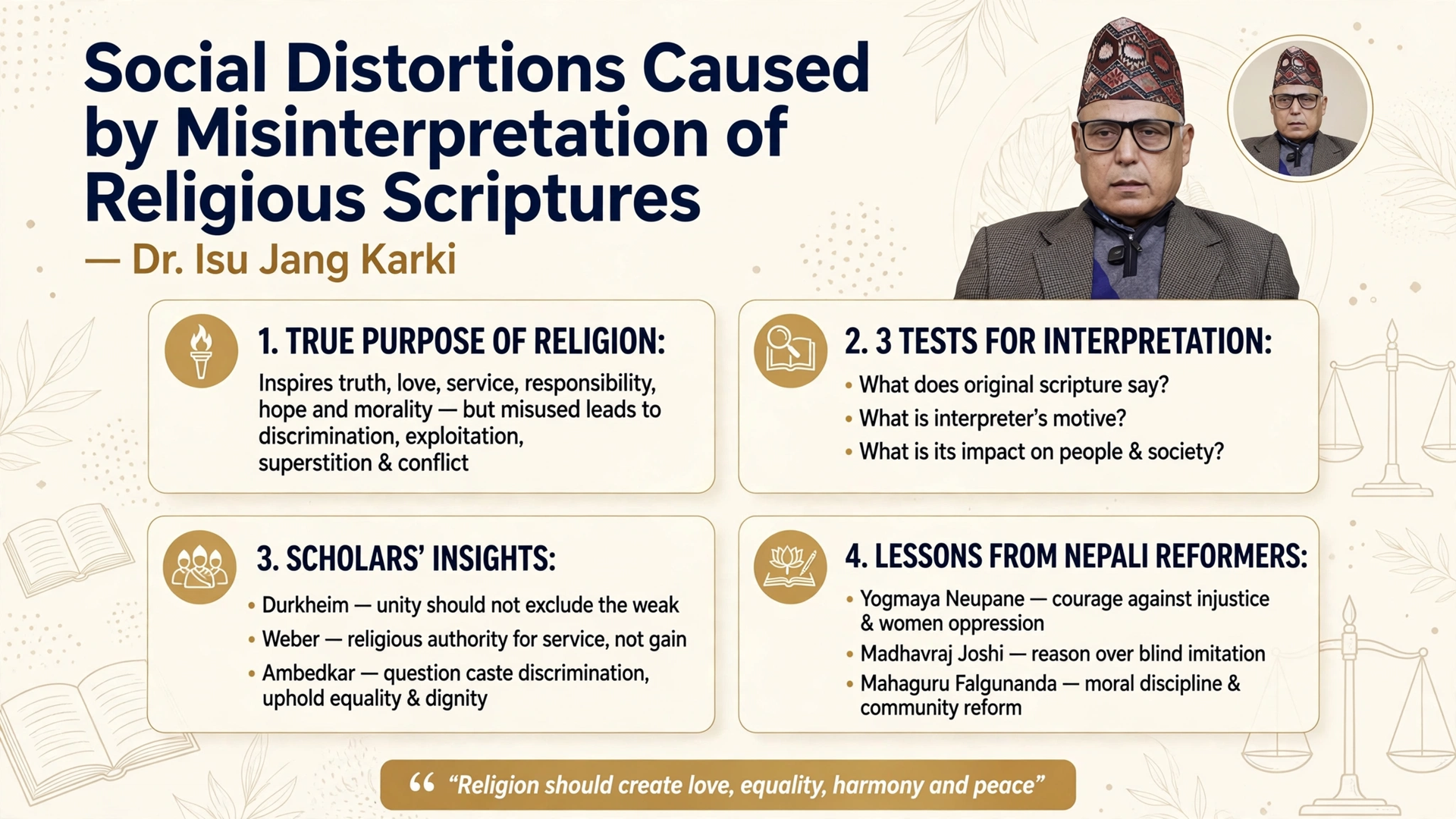
It is not appropriate to limit the definition of Dharma to only what is suitable for a person to adopt or to acts performed merely for customary practice. On the other hand, religious practice cannot be dismissed as opium or falsehood. Changes in human thinking and consciousness should also be included within the scope of religion. Religion can inspire a person to speak the truth, do good deeds, love others, help those in distress, and become responsible towards society. Religion also gives a person hope, morality, and a foundation for living life. But if religion is misinterpreted or used for selfish interests, it can also increase discrimination, exploitation, superstition, and conflict in society.
Misinterpretation of religious scriptures means interpreting the true message and context of religious texts without understanding them, according to one’s own self-interest. Sometimes people take refuge in religion to establish their old customs, personal views, or authority. In this way, even wrong practices are attempted to be justified in the name of religion.
Such a problem is not limited to any single religion. It can be seen in different forms in various religions and communities. In a multi-religious, multi-ethnic, and multicultural country like Nepal, where religion has a significant influence on people’s lives, culture, family, and social relations, it is necessary to study this subject.
The purpose of this article is not to insult any religion or religious community. The main objective of this article is to identify injustice and wrong practices that occur in the name of religion, to understand their causes, and to help establish truth, justice, equality, and human dignity in society.
- Interpretation of Religious Scriptures and Social Behavior
What is written in the original religious text is important. But how it is understood and how it is applied in daily life is equally important.
The same religious teaching can be understood differently by different people. Some may learn lessons of love, service, and justice from it, while others may misinterpret it to fulfill their own self-interest. In the name of religion, people can even become fanatical and inhuman.
It is not the case that a tradition that has been going on for a long time is always right. If a custom insults people, discriminates against them, or deprives them of their rights, it must be reviewed.
When understanding religious teachings, attention needs to be paid to three things:
What does the original religious text actually intend to say?
What is the objective of the person interpreting it?
What kind of impact is that interpretation having on people and society?
Instead of justifying injustice in the name of religion, attention should be paid to how religious teachings can inspire people towards a good life and social responsibility. Religion should create love, equality, harmony, and peace.
- Scholars’ Views on Religion and Society
Various sociologists and thinkers’ studies are useful to understand the impact of religion on society.
Emile Durkheim studied how religion can unite people through shared beliefs and practices. But if the unity of a community is based on excluding others or suppressing the weak, such unity is not just.
Max Weber studied the relationship between religion, economic life, social prestige, and power. His ideas help us understand how religious institutions and leadership influence society. The question of whether religious authority is used for service or for personal gain is also important.
Dr. Bhimrao Ramji Ambedkar raised his voice in favor of equality and human dignity while opposing caste discrimination and untouchability. His thoughts inspire us to question the practice of judging people as high and low based on birth or caste.
The studies of these thinkers help us understand religion not only as a personal belief but also as an aspect that influences society and human behavior. The issue of how religious leaders should remain neutral from political and economic influence is also important.
- Lessons Learned from Reformers of Nepali Society
In the history of Nepal too, there are various personalities who raised their voices against unjust social practices. Their lives and contributions show that courage, wisdom, and moral responsibility are necessary for social reform.
4.1 Yogmaya Neupane
Yogmaya Neupane raised her voice against the injustices, oppression of women, and social evils that existed in the society of that time. Her life teaches that every practice prevailing in society should not be considered right merely because it is a tradition.
From her struggle, the importance of respect for women, social justice, and the courage to speak against injustice can be understood. Her life shows that religious and moral consciousness can also become a means of social change.
4.2 Madhavraj Joshi
Madhavraj Joshi is known as a personality of reformist consciousness associated with the Arya Samaj in Nepal. His contribution can be understood in the context of a reformist effort that questioned the religious and social beliefs of the time.
His context reminds us of the need to understand religious faith not limited to blind imitation but on the basis of reason and morality. Reviewing tradition does not mean insulting faith; it is also an attempt to identify wrong practices.
4.3 Mahaguru Falgunanda Lingden
Mahaguru Falgunanda Lingden is known as an important religious and social reformer of the Kirat religious tradition.

Dr. Isujung Karki
Pastor and Christian Leader Kathmandu, Nepal