Religious Freedom, Secularism, Social Inclusion and Political Accountability in Nepal
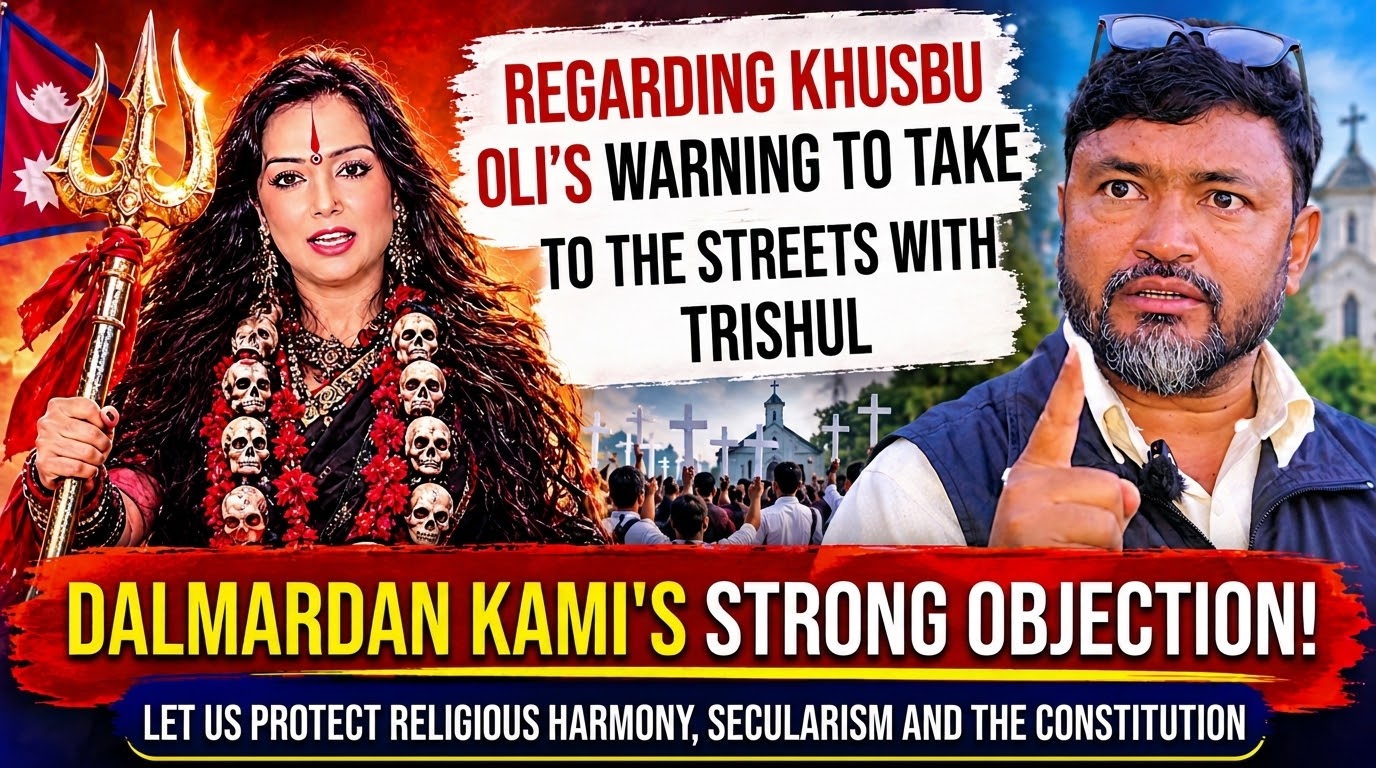
Nepal has recently witnessed increasingly intense public debates surrounding religion, politics and social identity. In particular, statements attributed to Khusbu Oli targeting Christian and Muslim communities, including a warning about taking up tridents and spears and entering the streets, have raised serious questions about religious harmony, citizens’ rights and the freedoms guaranteed by the Constitution of Nepal.
Responding to these developments, Dal Mardan Kami, a leader of the United Citizens Party (Sanyukta Nagarik Party), has strongly criticized Khusbu Oli’s remarks in a televised interview. He argued that threatening citizens on the basis of their religious beliefs, using the language of weapons and encouraging society towards religious confrontation are unacceptable in a democratic country.
His remarks have brought renewed attention to the protection of religious minorities, the importance of secularism and the responsibility of the state to safeguard the rights of all citizens.
1. Dal Mardan Kami Questions Khusbu Oli’s Threat to Take Up Tridents and Spears
Dal Mardan Kami has argued that Khusbu Oli’s reported statement about taking up tridents and spears and coming onto the streets cannot simply be dismissed as ordinary political rhetoric.
He expressed particular concern that such language was being used in a context where Christian communities are peacefully praying, practising their faith and wishing for peace, stability and prosperity in the country.
Kami raised a fundamental question: Are Christians not citizens of Nepal? Do they not have the right to pray according to their faith, practise their religion and participate peacefully in religious activities?
Directly challenging Khusbu Oli, Kami questioned what kind of message such threatening language sends to a religiously diverse society.
He also connected the issue to the historical oppression of Dalits and Shilpi communities, particularly those who have experienced untouchability and discrimination associated with caste-based Hindu extremism.
His central message was clear: Nepal belongs to citizens of all religions and communities. No religious group has the right to intimidate another.
2. Targeting Christians and Muslims Contradicts Democratic Values
Nepal is a multi-religious, multi-ethnic and multicultural country. Hindus, Buddhists, Christians, Muslims, Kirat communities and people belonging to other faiths have made Nepal their home.
Having a different religion does not make someone less Nepali. Religious differences do not diminish anyone’s national identity or citizenship.
Dal Mardan Kami interpreted the remarks attributed to Khusbu Oli as a challenge to this fundamental diversity.
He particularly questioned why Christians, who pray for peace, stability and prosperity in the country, should become targets of aggressive and threatening language.
This is not merely an issue concerning Christians. It also concerns Muslims and all other religious minorities.
If Christians can be intimidated today because of their religious identity, another religious community could face similar treatment tomorrow.
Therefore, defending religious freedom is not about supporting one particular religion against another. It is about protecting the equal rights and dignity of every citizen.
3. Who Has the Authority to Mobilize Religious Leaders for Political Movements?
Another important issue raised by Dal Mardan Kami concerns attempts to mobilize religious leaders for political purposes.
According to Kami, religious leaders have their own spiritual, moral and social responsibilities. They should not be treated as instruments for fulfilling the political interests of individuals or political parties.
He questioned the appropriateness of calling religious leaders to participate in street movements for political objectives.
His argument is that if a political leader believes that constitutional or legal changes are necessary, the appropriate approach is to present those demands through Parliament and established democratic processes.
Using religious communities to generate political pressure or mobilizing them through emotionally charged religious rhetoric is not a healthy democratic practice.
This raises an important question: Should religion become a weapon in political competition, or should it serve as a foundation for peace, tolerance and moral responsibility?
Religious leaders must be able to rise above political pressure and stand for peace, coexistence and national unity.
4. Secularism and the Constitutional Debate
Dal Mardan Kami also criticized what he described as attacks on federalism, secularism and proportional inclusion, which are fundamental features of Nepal’s constitutional framework.
According to him, these achievements were not gifts from any individual or political party. They emerged from decades of political struggles, public movements, sacrifices and people’s aspirations.
The Constitution of Nepal recognizes secularism as a fundamental characteristic of the state.
Article 4 defines Nepal as a secular state, while Article 26 guarantees the right to freedom of religion. Article 18 guarantees the right to equality, and Article 274 establishes the constitutional procedure for amendments.
This does not mean that secularism cannot be debated or that citizens cannot express different political opinions about the existing constitutional arrangements.
However, any proposed changes must follow democratic and constitutional procedures, not religious hatred, intimidation or threats of violence.
Kami acknowledged that there are weaknesses in the way secularism is currently practised in Nepal. He suggested that the system could be improved and made more effective.
However, he strongly opposed any attempt to weaken religious freedom and equal citizenship in the name of reform.
5. Questions for Prime Minister Balen Shah and Rabi Lamichhane
During the interview, Kami also questioned the roles and responsibilities of Prime Minister Balen Shah and Rabi Lamichhane, chairman of the Rastriya Swatantra Party (RSP).
He argued that those holding positions of political leadership must take seriously statements and activities that could increase religious and social tensions.
He emphasized that the government has a responsibility to protect religious minorities, Dalits, landless communities and other marginalized sections of society.
He also criticized what he described as attempts to politicize and undermine public institutions, particularly the police administration.
In his view, political leaders who receive public mandates must accept responsibility for protecting the rights and security of every citizen.
Winning an electoral majority does not give any government permission to undermine the rights of minorities.
6. Nepal Needs Peace and Coexistence, Not Religious Conflict
One of the most significant aspects of Dal Mardan Kami’s interview was his appeal for peace.
He urged Khusbu Oli and other political actors not to push Nepal towards religious confrontation and instability.
Nepal has already paid a heavy price for political violence, conflict and instability. The country should not choose another path of religious or communal confrontation.
Instead of dividing people in the name of religion, Nepal should recognize its religious diversity as a foundation for national unity.
Kami’s message was that national development and prosperity are possible only when all ethnicities, religions, languages, cultures and communities are respected.
Religious diversity should be a source of strength, not a reason for hostility.
7. The Concept of Inclusive Social Democracy Across All Ethnic Communities
Another significant subject discussed in the interview was Kami’s political philosophy of Sarvajatiya Samabeshi Samajik Loktantra, which can be translated as Inclusive Social Democracy Across All Ethnic Communities.
According to him, Nepal cannot achieve sustainable development and prosperity without recognizing and embracing its social, religious, ethnic, geographical and cultural diversity.
He emphasized the historical contributions of Dalit and Shilpi communities, arguing that these communities have played an essential role in the development of human civilization through their skills, craftsmanship, creativity and artistic contributions.
Despite their contributions, many members of these communities continue to experience discrimination and exclusion.
Kami argued that they must receive equal opportunities in political leadership, state institutions and policymaking.
In his view, respecting marginalized communities, ensuring their representation and providing them with leadership opportunities are essential requirements for social justice.
However, this political philosophy also requires further policy clarification and public discussion regarding how it can be implemented in practice.
8. What Should Be the Role of the State Regarding Khusbu Oli’s Statements?
The controversy also raises important questions about the responsibilities of the government, political parties, security agencies and human rights institutions.
Every citizen has the right to express religious and political opinions. However, freedom of expression does not provide anyone with the right to threaten another community or encourage religious hatred and violence.
Article 17 of Nepal’s Constitution guarantees freedom of opinion and expression, subject to constitutional and legal limitations.
In this context, the state should take the following responsibilities seriously:
1. Impartial investigation: If statements or activities involve threats of violence against religious communities, the authorities should investigate them impartially.
2. Protection of religious communities: The government must ensure the safety of Christians, Muslims, Hindus, Buddhists and all other religious communities without discrimination.
3. Equal enforcement of the law: Laws addressing religious hatred, intimidation and communal provocation must be enforced equally, regardless of political influence or religious identity.
4. Responsible religious and political leadership: Religious leaders and political representatives should be encouraged to promote social harmony and peaceful coexistence.
5. Clear government position: The government should publicly clarify its commitment to religious freedom, secularism and equal citizenship.
The implementation of the law must never depend on an individual’s political influence, religious identity or social status.
Conclusion: Nepal Needs Constitutional Democracy and Peace, Not the Politics of Tridents and Spears
The statements attributed to Khusbu Oli regarding taking up tridents and spears and entering the streets have raised serious concerns about religious coexistence in Nepal.
The questions raised by Dal Mardan Kami go beyond the protection of Christian and Muslim communities. They concern the democratic character of Nepal, the constitutional commitment to secularism and the principle of equal citizenship.
Every religious community has the right to practise its faith, express its beliefs, pray and participate in peaceful religious activities. Hindus, Buddhists, Muslims, Christians, Kirat communities and followers of other faiths must enjoy equal rights and protection.
The future of Nepal does not depend on religious competition, hatred or the language of weapons. It depends on mutual respect, justice, equality and peaceful coexistence.
Whether Khusbu Oli or any other political leader, everyone must understand one fundamental reality: Nepal does not belong exclusively to any one religion, caste or ideology. It is the common homeland of all Nepalis.
Tridents and spears cannot unite society. The real forces that unite a nation are its Constitution, justice, equality, religious freedom and mutual respect.
Editorial Note
This article is based on the interview with Dal Mardan Kami. Statements concerning Khusbu Oli are presented as allegations, interpretations and political responses expressed by Kami during the interview; they should not be treated as independently verified facts. Before publication, it would be appropriate to review the original video and the full context of Khusbu Oli’s statements and provide an opportunity for her response.
Source: Interview with Dal Mardan Kami, Strong Reply to Khusbu Oli Trying Weapons Against Christians and Muslim, YouTube.

Socioligist, Communication Expert, Certified Mediator, Certified Community Legal Document Assistant, Coach, Writer, Translator cum Interpreter, YouTuber, Master Teacher of some biblical training, Content Creator.
Contact for above services and consultation:
thomasbogaty@gmail.com
Watsapp: +977-9813249433
CHARGES AS PER THE SERVICE