Abstract
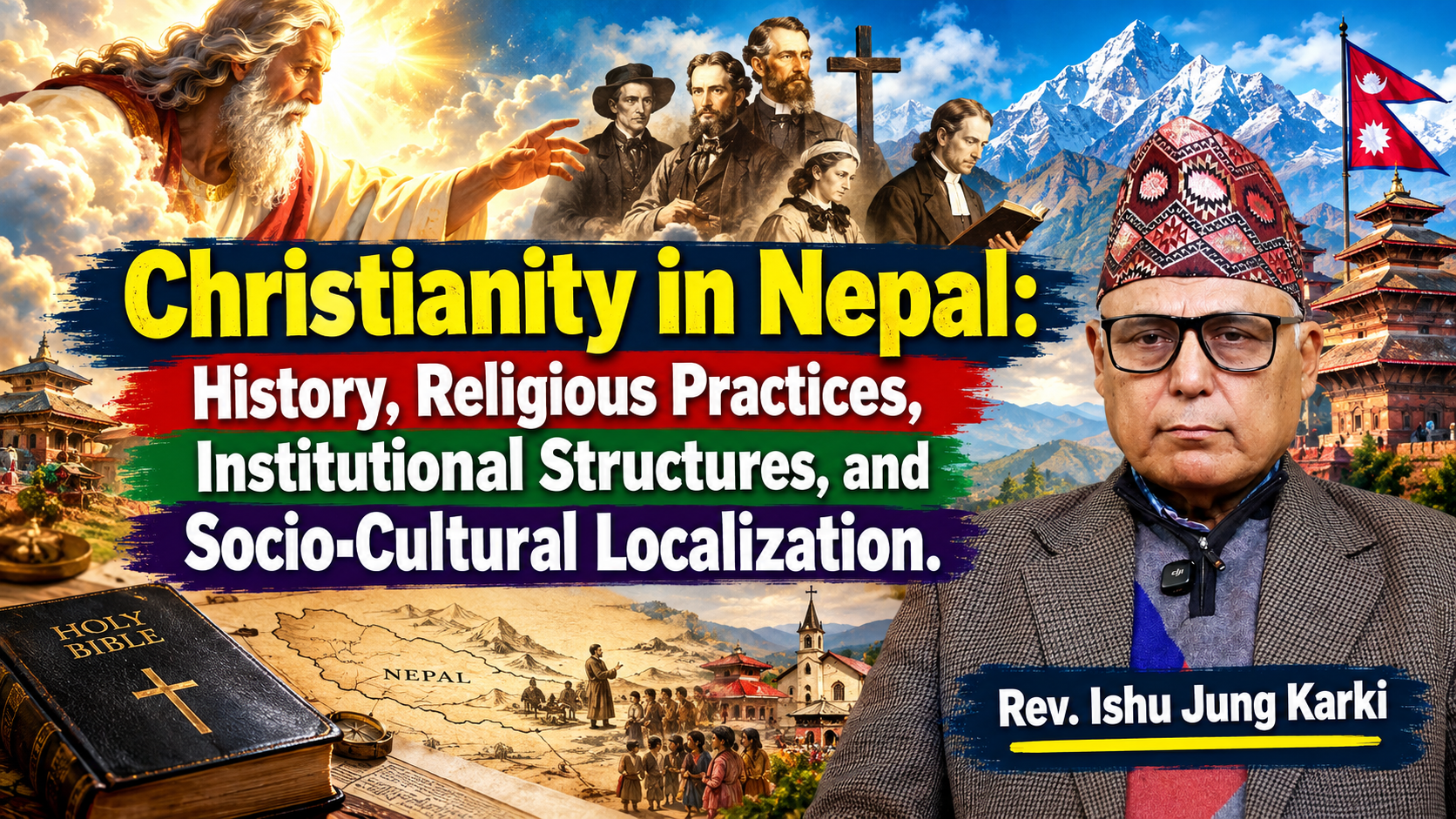
Christianity in Nepal has developed through a complex interaction of history, religion, culture, ethnicity, political transformation, constitutional change, and globalization. Although Christians remain a minority population, Christianity has become increasingly visible through churches, theological institutions, educational initiatives, humanitarian organizations, social-service activities, and diverse forms of worship. According to Nepal’s 2021 National Population and Housing Census, 512,313 people, or 1.76 percent of the population, identified as Christian.¹
(There is no uniformity in the figures regarding the number of Christians in Nepal provided by the Christian community; instead, varying figures are found.)
This article examines Christianity in Nepal through historical, sociological, theological, institutional, and cultural perspectives. Rather than treating Christianity simply as an imported religious tradition or interpreting Christian growth primarily through numerical expansion, the study analyzes Christianity as a developing social and religious phenomenon embedded within Nepal’s changing religious landscape. Particular attention is given to contextualization, inculturation, vernacularization, religious identity, secularization, conversion, institutionalization, and lived religion. The study engages the work of Nepal scholars such as Bal Krishna Sharma, David N. Gellner, Chiara Letizia, and Sara Shneiderman, together with wider theological discussions by Stephen B. Bevans, Robert J. Schreiter, Andrew F. Walls, LaminSanneh, and Lesslie Newbigin. The article argues that the development of Christianity in Nepal cannot adequately be explained through a simple opposition between “Christianity” and “Nepali culture.” Christianity has historically interacted with Nepali languages, ethnic identities, social structures, cultural practices, and political institutions. This interaction has generated processes of adaptation, negotiation, resistance, and transformation. Contextualization therefore involves more than translating Christian vocabulary into Nepali; it requires theological reflection on how Christian faith is interpreted and embodied within a particular cultural and social environment. At the same time, contextualization cannot mean the uncritical acceptance of every cultural or religious practice. The study concludes that the future development of Christianity in Nepal should be analyzed in terms of theological integrity, cultural intelligibility, institutional maturity, constitutional awareness, social responsibility, and constructive participation in a religiously plural society. Keywords: Christianity in Nepal; contextualization; inculturation; vernacularization; secularism; religious identity; conversion; lived religion; church; religious freedom; sociology of religion ⸻
- Introduction
Nepal is characterized by considerable religious, ethnic, linguistic, and cultural diversity. Hinduism, Buddhism, Kirat traditions, Islam, Christianity, Bon, Prakriti, and other religious traditions form part of the country’s contemporary religious landscape. The 2021 National Population and Housing Census recorded ten religious affiliations and reported Christianity at 1.76 percent of the national population.² Christianity therefore remains a minority tradition, but its social visibility has increased significantly during the modern period. The academic study of Christianity in Nepal requires more than a chronological account of missionary activity. It requires attention to the relationship between religion and society, religious identity and ethnicity, conversion and social change, church institutions and globalization, and Christian theology and local culture. Christianity in Nepal may therefore be examined through the sociology of religion as well as through theology and missiology. Bal Krishna Sharma notes that Christian contact with Nepal can be traced to 1662, when Italian Capuchin priests passed through Nepal while traveling toward Tibet.³ The subsequent history of Christianity, however, developed through several distinct phases and should not be reduced to a single missionary narrative. Contemporary Christianity emerged through interaction among foreign missions, Nepali converts, indigenous leadership, churches, theological institutions, and changing political structures. This article employs an interdisciplinary approach. Historically, it considers the development of Christianity from early Catholic contact to contemporary indigenous churches. Sociologically, it considers Christianity as a minority religious institution operating within a plural society. Theologically, it examines contextualization and the relationship between Christian faith and culture. Politically and legally, it examines the implications of Nepal’s transition from a Hindu monarchy to a secular federal democratic republic. The central question is therefore not simply how Christianity entered Nepal, but how Christianity has been interpreted, institutionalized, practiced, and localized within Nepali society. - Methodological and Conceptual Framework This study uses a qualitative, interdisciplinary, literature-based approach. It draws upon historical scholarship, sociology of religion, missiology, theological literature, constitutional documents, legal texts, and national census data. It does not attempt to provide an exhaustive ethnographic study of all Christian communities in Nepal. Rather, it develops an analytical framework for understanding major patterns in the historical and socio-cultural development of Christianity. Four concepts are particularly important: contextualization, inculturation, vernacularizing, and institutionalization. 2.1 Contextualization Stephen B. Bevans argues that theology is necessarily contextual because Christian theological reflection always takes place within particular historical, cultural, social, and intellectual contexts. In Models of Contextual Theology, Bevans identifies six approaches: translation, anthropological, praxis, synthetic, transcendental, and counter-cultural models.⁴ This framework is useful for Nepal because Christian communities face the question of how Christian theology should be expressed in a society whose cultural and religious assumptions differ significantly from those of Europe or North America. Contextualization should therefore not be understood merely as making Christianity culturally attractive. It involves a process of theological interpretation in which Scripture and Christian tradition are brought into critical conversation with a particular social context.
2.2 Inculturation Robert J. Schreiter’s concept of local theology provides another important framework. Schreiteremphasizes that local theology develops through interaction among Christian tradition, local culture, and the concrete experiences of Christian communities.⁵ His approach challenges the assumption that theological formulations developed within one dominant culture can simply be transferred unchanged into another. For Nepal, this raises questions concerning worship, language, music, family relationships, community structures, social hierarchy, and religious symbols.
2.3 Vernacularization Andrew F. Walls and Lamin Sannehprovide another important perspective. Walls emphasizes the historical “translation” of Christianity across cultures, while Sanneh particularly highlights vernacularization—the process through which Christianity becomes expressed through local languages and cultural forms.⁶ This concept is especially relevant to Nepal. Christianity becomes socially localized when biblical concepts, Christian songs, preaching, theological education, liturgical practices, and community structures are increasingly expressed through Nepali and other indigenous languages.
2.4 Institutionalization From a sociological perspective, Christianity can also be understood as an institutional process. Churches develop organizational structures, leadership systems, educational institutions, financial practices, rituals, norms, and mechanisms of authority. Christianity therefore becomes more than individual belief; it becomes a social institution. This institutional perspective allows the study to ask not only how many Christians exist, but how Christian communities organize themselves, reproduce leadership, educate members, manage resources, and interact with wider society. - Historical Development of Christianity in Nepal The historical development of Christianity in Nepal may be divided analytically into four broad phases: early Catholic contact, restricted development under the traditional political order, twentieth-century Protestant and evangelical expansion, and post-1990 indigenous institutional diversification.
3.1 Early Catholic Contact The earliest documented Christian contact identified in modern scholarship dates to 1662, when Italian Capuchin priests passed through Nepal on their way to Tibet.⁷ This history is important because it demonstrates that Christianity is not exclusively a late twentieth-century phenomenon. The Capuchin presence, however, should not be equated with the later development of Nepalese Christianity. The historical circumstances, institutional structures, and social environment were substantially different.
3.2 Political Restrictions and Limited Institutional Development For long periods, Nepal’s political structures restricted the institutional development of Christianity. Christian communities therefore remained relatively small and lacked the extensive institutional networks visible in contemporary Nepal. The political transformation of the twentieth century gradually altered this environment. Increased international contact, educational development, political change, and the growth of organized Christian missions contributed to new opportunities for Christian institutional development.
3.3 Expansion after Political Liberalization The political changes of the late twentieth century created a significantly different environment for religious organizations. The restoration of multiparty democracy in 1990 and subsequent political transformations contributed to greater public religious diversity. The contemporary development of Christianity should consequently be understood within Nepal’s wider political transformation rather than as an isolated religious event. - Christianity as a Minority Religious Tradition The 2021 census recorded 512,313 Christians, representing 1.76 percent of Nepal’s population.⁸ The census also recorded Hinduism at 81.19 percent, Buddhism at 8.21 percent, Islam at 5.09 percent, and Kirat at 3.17 percent.⁹ These figures are sociologically important. Christianity has experienced substantial growth over the period covered by recent censuses, but it remains a minority tradition. Consequently, Christian identity in Nepal develops within a social environment in which Christians interact with religious traditions that possess much deeper historical institutional roots. Minority status also affects public perceptions of religious identity. Christianity may simultaneously be experienced by Christians as an indigenous lived faith and perceived by some outside observers as an externally introduced religion. This tension makes the concepts of religious identity and social location particularly important.
- Religious Identity and Conversion David N. Gellner’s study of conversion in the Kathmandu Valley provides a significant sociological framework for understanding religious change. Gellner argues that conversion itself is not a modern invention, but that its political significance increases when religious boundaries become more sharply defined through modern institutions such as censuses, elections, majority politics, and identity categories.¹⁰ This perspective is important for Nepal because religious identity may intersect with caste, ethnicity, language, locality, family, and political identity. Conversion therefore should not automatically be explained through a single factor. Individual conversion may involve theological conviction, personal religious experience, social relationships, community belonging, experiences of discrimination, marriage, family change, or other circumstances. These possibilities require empirical research rather than generalized assumptions. The sociological concept of religious conversion should consequently be distinguished from the theological concept of conversion as repentance and commitment to Christian faith. The former is an analytical category used to describe religious change; the latter is a theological interpretation of that change.
- Secularization and the Transformation of the Nepali State Nepal’s transition from a Hindu monarchy to a secular federal democratic republic significantly altered the relationship between religion and the state. Gellner and Letizia observe that the Hindu identity of the Nepali state became particularly explicit and politicized between 1960 and 1990. After 1990, and especially following the civil conflict, secularism became increasingly institutionalized. They further argue that the 2015 Constitution reflects competing understandings of secularism and a changing conception of Hinduism as one religion among several rather than simply an inherited state identity.¹¹ This development can be analyzed through the sociological concept of secularization. Secularization does not necessarily mean the disappearance of religion. In Nepal, the process has instead involved a restructuring of the relationship between religious institutions, state authority, citizenship, and public identity. Consequently, secular Nepal should not be understood as a society without religion. It is better understood as a society in which the state formally operates within a constitutional framework that recognizes religious diversity while continuing to regulate aspects of religious practice.
- Constitutional Religious Freedom The Constitution of Nepal identifies the state as secular and provides for religious freedom. Article 26 recognizes the freedom to profess, practice, and protect one’s religion. At the same time, Article 26(3) places constitutional limits on activities that convert another person from one religion to another or interfere with another person’s religion.¹² This creates an important legal distinction between religious freedom and conversion-related activity. For Christian communities, the distinction has practical implications. Worship, prayer, Bible study, theological education, Christian fellowship, and charitable activity belong to different categories of activity than efforts specifically directed toward conversion. The constitutional framework therefore needs to be considered when analyzing Christian mission in Nepal.
- Legal Regulation of Conversion Nepal’s legal framework goes beyond the constitutional provision. Section 158 of the Muluki Criminal Code, 2074, prohibits causing another person to convert, attempting to do so, or encouraging conversion. It also addresses conduct intended to disturb established religious belief or faith for purposes of conversion. The provision establishes penalties of imprisonment of up to five years and a fine of up to NPR 50,000.¹³ The existence of these restrictions is important for understanding contemporary Christian ministry in Nepal. At the same time, legal analysis should distinguish between the existence of a legal restriction and the empirical question of how the law is interpreted and enforced. Those questions require separate study. A scholarly analysis should therefore avoid both extremes: assuming that all Christian activity constitutes illegal conversion, or assuming that constitutional religious freedom removes all legal restrictions on proselytization.
- Christianity and Nepali Culture The relationship between Christianity and culture represents one of the most important questions in Nepalese Christian studies. A simplistic model would assume that Christianity is Western and Nepali culture is non-Christian. Such a model fails to recognize that Christianity has historically existed in many cultures and has repeatedly developed local forms. Walls’s historical analysis emphasizes that Christianity has continually crossed cultural boundaries and developed new centers within different cultural environments.¹⁴ Sannehsimilarly emphasizes the significance of vernacular translation in the transmission of Christianity.¹⁵ From this perspective, Christianity does not possess only one legitimate cultural form. Nepali Christianity can therefore employ Nepali languages, local music, indigenous instruments, culturally appropriate clothing, local architecture, and community practices without automatically becoming theologically non-Christian.
- Contextualization and the Problem of Cultural Adaptation Contextualization nevertheless involves a theological problem: How much can Christianity adapt to culture without losing its theological identity? Bevans’s models demonstrate that different theological approaches answer this question differently. The translation model emphasizes the transmission of an established Christian message into a new cultural setting. The anthropological model places greater emphasis on discovering Christian meaning within the culture itself. The praxis model emphasizes social practice and transformation. The synthetic model emphasizes dialogue among Scripture, tradition, culture, and experience. The counter-cultural model emphasizes the critical capacity of Christian faith to challenge aspects of culture.¹⁶ This theoretical framework is particularly useful for Nepal because Christian communities encounter practices that are simultaneously cultural and religious. For example, respect for elders, hospitality, removing shoes before entering a house, local musical styles, and community celebrations may function primarily as cultural practices. Religious worship directed toward a deity is different because it possesses explicitly religious significance. Contextualization therefore requires cultural discernment.
- Culture, Religion, and the Concept of “Lived Religion” The concept of lived religion is useful for examining Christianity in Nepal because religious identity is expressed not only through formal doctrines but also through everyday practices. Christianity is lived through family relationships, food, language, music, work, marriage, education, festivals, funerals, community gatherings, and social networks. This perspective prevents researchers from reducing Christianity to Sunday worship or formal doctrinal statements. For example, a Nepali Christian may retain traditional forms of respect toward elders while changing the religious interpretation associated with certain practices. Such changes demonstrate that conversion does not necessarily produce complete cultural discontinuity. Religious identity is therefore negotiated within everyday social life.
- Christianity and Ethnic and Caste Identity Christianity in Nepal has also interacted with caste and ethnicity. The 2021 census demonstrates significant differences in religious affiliation across broad caste and ethnic categories. Christianity was identified among several social groups, illustrating that Christian affiliation cannot be understood exclusively as an ethnic- or caste-specific phenomenon.¹⁷ The sociology of religion therefore provides an important analytical tool. Christianity can function simultaneously as a religious identity, a community identity, and, in some contexts, a mechanism through which individuals renegotiate social relationships. However, such claims should not be generalized without empirical research. The relationship among conversion, caste, ethnicity, dignity, and social mobility differs across communities.
- Christian Institutional Structures The development of Christianity in Nepal has produced increasingly complex institutional structures. These include local congregations, denominational organizations, independent churches, Bible schools, seminaries, Christian educational institutions, humanitarian organizations, fellowships, youth ministries, women’s ministries, and international networks. Institutionalization creates both opportunities and challenges. On the one hand, institutional structures provide continuity, theological education, leadership development, social organization, and mechanisms for collective action. On the other hand, institutional growth creates questions concerning financial accountability, leadership authority, pastoral training, organizational transparency, succession, denominational competition, and relationships between local churches and international organizations. The sociology of institutions therefore allows Christian development to be examined beyond numerical growth.
- Indigenous Leadership and Localization A major characteristic of contemporary Christianity in Nepal is the increasing role of Nepali Christian leadership. Localization involves more than transferring foreign leadership positions to Nepali individuals. It includes the development of local theological reflection, indigenous worship, local leadership structures, locally relevant preaching, and theological education addressing Nepal’s social realities. Schreiter’s concept of local theology is relevant here because it suggests that theology develops through the interaction of Christian tradition with local culture and experience.¹⁸ Thus, the development of Nepali theology should not simply reproduce theological categories developed in Western contexts. It should also engage questions emerging from Nepali society, including caste, ethnicity, migration, poverty, family structures, religious pluralism, social exclusion, disaster response, and constitutional religious freedom.
- Vernacularization and Christian Worship Language represents one of the most important mechanisms of localization. Christianity becomes more deeply embedded within a society when Scripture, worship, preaching, theological education, songs, prayers, and Christian literature become available in local languages. Sanneh’s concept of vernacularization is particularly significant because he argues that Christian mission has historically involved the translation of the Christian message into local languages rather than simply imposing one linguistic culture upon another.¹⁹ In Nepal, the use of Nepali and other local languages has therefore contributed to the development of Christian communities that are culturally distinguishable from their foreign missionary origins.
- Music, Architecture, Clothing, and Other Cultural Forms Christian cultural localization can also be observed through music, architecture, clothing, food, and social customs. Nepali Christian worship may employ local instruments and musical styles. Church buildings may reflect either international Christian architectural forms or local architectural patterns. Christian families may retain Nepali clothing and forms of hospitality. These practices illustrate an important distinction between cultural form and theological meaning. A musical instrument does not possess a Christian or non-Christian identity merely because of its cultural origin. Likewise, wearing traditional Nepali clothing does not determine theological identity. The theological question is whether the cultural form communicates or embodies meanings that are compatible with Christian faith.
- Christian Identity and Religious Boundaries Contextualization nevertheless has limits. Christianity cannot be localized simply by incorporating every available cultural practice. Religious symbols and practices can carry meanings that are incompatible with Christian theological convictions. This is where Bevans’s counter-cultural model becomes particularly relevant. Christian theology may affirm aspects of culture while simultaneously challenging other aspects.²⁰ The distinction may therefore be expressed through three categories: 1. Cultural practices that can be affirmed; 2. Cultural practices that can be adapted or transformed; and 3. Religious practices that require theological rejection. Such a framework avoids both cultural rejection and uncritical accommodation.
- Old Testament Practices and the New Testament Church The question of Old Testament practices illustrates the importance of theological discernment. The Old Testament contains Sabbath regulations, festivals, dietary laws, sacrificial systems, priesthood, ritual purity, and other covenantal practices. The New Testament, however, presents the work of Christ in relation to the old covenant and interprets these matters within the framework of the new covenant. Hebrews 8–10 is therefore central to Christian theological analysis of covenant continuity and discontinuity. Colossians 2:16–17 and Romans 14:5–6 are also significant for questions concerning religious days. Acts 15 provides an especially important example. The Jerusalem Council did not simply require Gentile believers to reproduce all aspects of Jewish religious practice. Instead, the early church engaged in theological discernment concerning how Gentile inclusion should be understood. This suggests that the first-century church itself faced the problem of cultural and religious diversity.
- Jewish Festivals and Christian Interpretation Passover, the Feast of Unleavened Bread, Pentecost, Trumpets, the Day of Atonement, and the Feast of Tabernacles have important theological significance within the Old Testament. Christian traditions differ concerning their continuing observance. Some Christian communities regard these festivals as continuing religious observances, while others interpret them primarily through Christ and the New Covenant. A scholarly analysis should therefore distinguish between: • studying Old Testament festivals; • recognizing their theological significance; • interpreting their fulfillment in Christ; and • regarding them as continuing mandatory religious obligations. These are not necessarily identical claims. The existence of a biblical practice does not by itself answer the theological question of how that practice functions within the New Covenant.
- Christian Festivals and Liturgical Diversity Christianity itself contains diverse traditions concerning Christmas, Easter, Pentecost, the church calendar, saints’ days, and other commemorations. This diversity demonstrates that Christian communities have historically developed different relationships with sacred time. Romans 14:5–6 provides an important theological resource for analyzing disagreements over particular days. The passage suggests that differences concerning days can exist within the Christian community without necessarily becoming the primary basis for Christian identity. Consequently, the study of Christian festivals in Nepal should be approached historically and theologically rather than through assumptions that one Christian calendar is universally normative.
- Religious Pluralism and Christian Public Theology Nepal’s religious diversity raises questions concerning Christian public theology. Lesslie Newbigin’s The Gospel in a Pluralist Society examines how Christianity relates to societies characterized by religious pluralism, cultural relativism, and secularization.²¹ He argues that Christian faith cannot simply withdraw from public culture; it must develop a coherent public witness. This concept is relevant to Nepal because Christians participate in a society where Christianity exists alongside Hindu, Buddhist, Kirat, Muslim, and other traditions. Christian public engagement therefore requires both theological conviction and civic responsibility. The objective need not be cultural domination. Rather, Christian communities can participate in public life through education, humanitarian work, social service, disaster response, dialogue, ethical action, and constructive citizenship.
- Christianity and Social Service Christian organizations and churches participate in education, health-related work, humanitarian assistance, community development, disaster response, poverty reduction, and other forms of social engagement. Theologically, Christian social action can be understood through the relationship between word and deed. Christian mission has historically included proclamation, discipleship, service, and care for vulnerable people. However, social service should be analyzed independently from conversion. If humanitarian assistance is interpreted merely as a mechanism for gaining converts, it may undermine the credibility of Christian social engagement. A more constructive approach understands social service as an ethical expression of Christian faith while maintaining appropriate boundaries between assistance and religious coercion.
- Human Dignity, Equality, and Social Ethics Christian theology contains important concepts of human dignity and equality. Genesis 1:26–27 presents humanity as created in the image of God, while Galatians 3:28 emphasizes a new identity within the Christian community that transcends social distinctions. Nepal’s constitutional framework also prohibits discrimination on grounds including religion, caste, and ethnicity.²² This creates an important area of interaction between Christian theology and public ethics. Christian communities can contribute to social transformation when theological commitments concerning human dignity are embodied in practices of equality, hospitality, justice, reconciliation, and service. This does not mean that Christianity should be reduced to social ethics. Rather, theological convictions can generate ethical implications for Christian participation in society.
- Christianity, Secularism, and the Public Sphere Sara Shneiderman’s research on temple building and secularization demonstrates that secularization in Nepal does not simply result in the disappearance of religion. Instead, religious identity, ethnicity, material culture, and state institutions continue to interact in complex ways.²³ This observation challenges classical assumptions that modernization necessarily produces religious decline. For Christianity, the implication is significant. Secular Nepal should not be interpreted as a post-religious Nepal. Rather, it is a context in which religious communities increasingly negotiate their identity within constitutional and pluralistic structures. Christianity therefore operates within a public sphere that is simultaneously secular in constitutional structure and deeply religious in social experience.
- Christianity as a Localized but Transnational Religion Christianity in Nepal demonstrates an important characteristic of contemporary religion: it is simultaneously local and transnational. Nepali churches may maintain relationships with international denominations, mission organizations, seminaries, theological networks, and global Christian movements while developing increasingly indigenous forms of leadership and worship. This produces a form of religious globalization in which local and global identities interact. The relationship is not necessarily one-directional. Nepalese Christians may receive theological resources from global Christianity while also contributing their own experiences, worship traditions, theological reflections, and missionary activity to the wider Christian movement. Thus, localization should not be confused with isolation from global Christianity.
- Christianity and the Concept of Glocalization The concept of glocalization provides another useful analytical category. Glocalization refers to the interaction between global forms and local contexts. Christianity provides a strong example because it is simultaneously a global religious tradition and a locally embodied religion. In Nepal, this can be seen when global Christian doctrines, songs, organizational forms, theological education, and denominational identities are interpreted through Nepali languages, relationships, cultural practices, and social structures. The resulting Christianity is neither completely foreign nor completely detached from global Christianity. It is a localized expression of a transnational religious tradition.
- The First-Century Church and Cultural Diversity The New Testament itself demonstrates that early Christianity developed within cultural diversity. The conflict between Jewish and Gentile believers, addressed particularly in Acts 15 and Galatians, demonstrates that the early church had to negotiate questions of identity, law, culture, and religious practice. The Jerusalem Council provides an important example of communal theological discernment. The issue was not simply whether one culture was superior to another. Rather, the early Christian community asked which practices were essential to Christian identity and which belonged to a particular cultural-covenantal context. This historical example provides a useful theological framework for contemporary Nepal.
- Analytical Discussion: From Missionary Christianity to Nepali Christianity The historical and theoretical evidence suggests that Christianity in Nepal has moved through a process that may be described as missionary introduction, institutional development, indigenization, localization, and contextualization. The first stage involved external Christian contact and missionary initiatives. The second involved the development of churches and Christian institutions. The third involved the emergence of indigenous Christian leaders and communities. The fourth involved the increasing use of Nepali languages, music, social structures, and cultural forms. The fifth involves the development of theological reflection appropriate to Nepal’s religious, cultural, constitutional, and social environment. This process should not be interpreted as a simple replacement of foreign Christianity by indigenous Christianity. Rather, it represents continuing interaction between global Christianity and local society.
- From Numerical Growth to Institutional and Theological Maturity Numerical growth is one indicator of religious development, but it is not the only one. A sociological analysis of Christian development should also examine: • theological education; • leadership formation; • institutional accountability; • financial transparency; • organizational sustainability; • indigenous theological reflection; • social engagement; • relationships with other religious communities; • constitutional literacy; and • participation in public life. This broader framework allows Christianity to be examined as a social institution rather than merely counted as a population category.
- Implications for Christian Studies in Nepal The analysis developed here suggests several areas for future research. First, empirical studies should examine the diversity of conversion experiences among different caste, ethnic, gender, generational, and regional communities. Second, research should investigate how Nepali Christian worship has changed across generations. Third, scholars should study the relationship between indigenous languages and Christian theological development. Fourth, the organizational structures of churches deserve systematic sociological study. Fifth, the relationship between Christianity and caste transformation requires further empirical investigation. Sixth, research should examine Christian participation in disaster response, education, health, poverty reduction, and other forms of public service. Finally, more work is needed on the development of specifically Nepali Christian theology.
- Conclusion Christianity in Nepal is best understood as a historically developing, socially embedded, culturally negotiating, institutionally organized, and constitutionally situated religious tradition. Its history extends beyond contemporary evangelical expansion. Early Catholic contact can be traced to the seventeenth century, while modern Christian institutional development occurred through later political, social, educational, and religious transformations.²⁴ The contemporary Christian population remains a minority, but the 2021 census demonstrates its increased demographic visibility.²⁵ The sociological significance of Christianity, however, cannot be measured only by population size. Its importance also lies in its interaction with questions of religious identity, caste, ethnicity, culture, social organization, and public life. The transformation of Nepal from a Hindu monarchy into a secular federal democratic republic changed the constitutional environment of religion. Gellner and Letiziademonstrate that secularization has not eliminated religion from Nepalese public life; rather, it has changed how religious identity is negotiated within the state.²⁶ Conversion likewise requires multidimensional analysis. Gellner’s study demonstrates that conversion becomes especially politically significant when religious boundaries become sharply defined through modern institutions and identity politics.²⁷ The concept of contextualization provides an important framework for understanding Christianity’s cultural development. Bevans demonstrates that Christian theology can relate to culture through several different models, while Schreiter emphasizes the emergence of local theology through interaction between Christian tradition and cultural context.²⁸ Walls and Sannehfurther demonstrate the importance of translation and vernacularization in the historical development of Christianity across cultures.²⁹ These perspectives suggest that Nepali Christianity should neither reject Nepali culture wholesale nor incorporate every cultural practice without theological examination. The central analytical conclusion is therefore that Christianity in Nepal should be understood as a process of socio-cultural localization rather than simply as the transplantation of a foreign religion. Localization involves translation, adaptation, institutional development, indigenous leadership, cultural negotiation, theological reflection, and participation in public life. At the same time, localization requires discernment because cultural forms and religious meanings are not always identical. A mature Christian presence in Nepal therefore involves three interconnected dimensions: theological integrity, cultural intelligibility, and social responsibility. The future study of Christianity in Nepal should consequently move beyond the question of whether Christianity is “foreign” or “indigenous.” A more productive scholarly question is how Christianity is continuously being translated, interpreted, institutionalized, negotiated, and lived within Nepali society. ⸻
(This is a chapter from the dissertation ( Church history and churches in Nepal)submitted by Isu Jung Karki for his PhD.)
Notes 1. National Statistics Office, Government of Nepal, National Population and Housing Census 2021: National Report on Caste/Ethnicity, Language and Religion (Kathmandu: National Statistics Office, 2023), table 14. 2. National Statistics Office, Government of Nepal, National Population and Housing Census 2021: National Report on Caste/Ethnicity, Language and Religion, table 14. 3. Bal Krishna Sharma, “Nepal,” in Christianity in South and Central Asia, ed. Kenneth R. Ross, Daniel Jeyaraj, and Todd M. Johnson (Edinburgh: Edinburgh University Press, 2019), 168–79. 4. Stephen B. Bevans, Models of Contextual Theology, rev. and expanded ed. (Maryknoll, NY: Orbis Books, 2002), 3–33, 37–139. 5. Robert J. Schreiter, Constructing Local Theologies (Maryknoll, NY: Orbis Books, 1985), 1–21, 39–68. 6. Andrew F. Walls, The Missionary Movement in Christian History: Studies in the Transmission of Faith (Maryknoll, NY: Orbis Books, 1996), 3–42; Lamin O. Sanneh, Translating the Message: The Missionary Impact on Culture, 2nd ed., rev. and expanded (Maryknoll, NY: OrbisBooks, 2008), especially 88–121. 7. Sharma, “Nepal,” 168–79. 8. National Statistics Office, National Population and Housing Census 2021, table 14. 9. Ibid. The 2021 census records Hindu 81.19 percent, Buddhist 8.21 percent, Muslim 5.09 percent, Kirat 3.17 percent, and Christian 1.76 percent. 10. David N. Gellner, “The Emergence of Conversion in a Hindu-Buddhist Polytropy: The Kathmandu Valley, Nepal, c. 1600–1995,” Comparative Studies in Society and History 47, no. 4 (2005): 755–80. 11. David N. Gellner and Chiara Letizia, “Hinduism in the Secular Republic of Nepal,” in The Oxford History of Hinduism: Modern Hinduism, ed. Torkel Brekke (Oxford: Oxford University Press, 2019), 275–304. 12. Government of Nepal, Constitution of Nepal, arts. 4 and 26. 13. Government of Nepal, Muluki Criminal Code, 2074, sec. 158. 14. Walls, TheMissionary Movement in Christian History, 3–42. 15. Sanneh, Translating the Message, 88–121. 16. Bevans, Models of Contextual Theology, 37–139. 17. National Statistics Office, Religion in Nepal: National Population and Housing Census 2021, especially the discussion of religious affiliation across caste and ethnic groups. 18. Schreiter, Constructing Local Theologies, 1–21, 39–68. 19. Sanneh, Translating the Message, 88–121. 20. Bevans, Models of Contextual Theology, 117–39. 21. Lesslie Newbigin, The Gospel in a Pluralist Society (Grand Rapids, MI: Eerdmans, 1989), especially the chapters “Contextualization, True and False,” “The Gospel and the Religions,” “The Gospel and the Cultures,” and “The Myth of the Secular Society.” 22. Government of Nepal, Constitution of Nepal, art. 18. 23. Sara Shneiderman, “Temple Building in Secularising Nepal: Materializing Religion and Ethnicity in a State of Transformation,” in Tolerance, Secularization and Democratic Politics in South Asia (Cambridge: Cambridge University Press, 2018), 75–107. 24. Sharma, “Nepal,” 168–79. 25. National Statistics Office, National Population and Housing Census 2021, table 14. 26. Gellner and Letizia, “Hinduism in the Secular Republic of Nepal,” 275–304. 27. Gellner, “The Emergence of Conversion,” 755–80. 28. Bevans, Models of Contextual Theology, 3–139; Schreiter, Constructing Local Theologies, 1–68. 29. Walls, The Missionary Movement in Christian History, 3–42; Sanneh, Translating the Message, 88–121. Bibliography Bevans, Stephen B. Models of Contextual Theology. Rev. and expanded ed. Maryknoll, NY: Orbis Books, 2002. Gellner, David N. “The Emergence of Conversion in a Hindu-Buddhist Polytropy: The Kathmandu Valley, Nepal, c. 1600–1995.” Comparative Studies in Society and History 47, no. 4 (2005): 755–80. https://doi.org/10.1017/S0010417505000344. Gellner, David N., and Chiara Letizia. “Hinduism in the Secular Republic of Nepal.” In The Oxford History of Hinduism: Modern Hinduism, edited by Torkel Brekke, 275–304. Oxford: Oxford University Press, 2019. Gellner, David N., Sondra L. Hausner, and Chiara Letizia, eds. Religion, Secularism, and Ethnicity in Contemporary Nepal. New Delhi: Oxford University Press, 2016. Government of Nepal. Constitution of Nepal. Kathmandu: Government of Nepal. Government of Nepal. Muluki Criminal Code, 2074. Kathmandu: Government of Nepal. National Statistics Office, Government of Nepal. National Population and Housing Census 2021: National Report on Caste/Ethnicity, Language and Religion. Kathmandu: National Statistics Office, 2023. National Statistics Office, Government of Nepal. Religion in Nepal: National Population and Housing Census 2021. Kathmandu: National Statistics Office, 2023. Newbigin, Lesslie. The Gospel in a Pluralist Society. Grand Rapids, MI: Eerdmans, 1989. Rajkumar, Peniel. “Inter-religious Relations.” In Christianity in South and Central Asia, edited by Kenneth R. Ross, Daniel Jeyaraj, and Todd M. Johnson, 384–95. Edinburgh: Edinburgh University Press, 2019. Sanneh, Lamin O. Translating the Message: The Missionary Impact on Culture. 2nd ed., rev. and expanded. Maryknoll, NY: Orbis Books, 2008. Schreiter, Robert J. Constructing Local Theologies. Maryknoll, NY: Orbis Books, 1985. Sharma, Bal Krishna. “Nepal.” In Christianity in South and Central Asia, edited by Kenneth R. Ross, Daniel Jeyaraj, and Todd M. Johnson, 168–79. Edinburgh: Edinburgh University Press, 2019. Shneiderman, Sara. “Temple Building in Secularising Nepal: Materializing Religion and Ethnicity in a State of Transformation.” In Tolerance, Secularization and Democratic Politics in South Asia, 75–107. Cambridge: Cambridge University Press, 2018. Walls, Andrew F. The Missionary Movement in Christian History: Studies in the Transmission of Faith. Maryknoll, NY: Orbis Books, 1996. The Holy Bible.

Dr. Isujung Karki
Pastor and Christian Leader Kathmandu, Nepal