Introduction
Religious institutions are expected to provide moral guidance, spiritual support, and a safe environment for their followers. People place deep trust in religious leaders and organizations, often considering them sources of compassion, integrity, and protection. However, when individuals in positions of religious authority exploit that trust, the consequences can be devastating—particularly when children and vulnerable people become victims of sexual abuse.
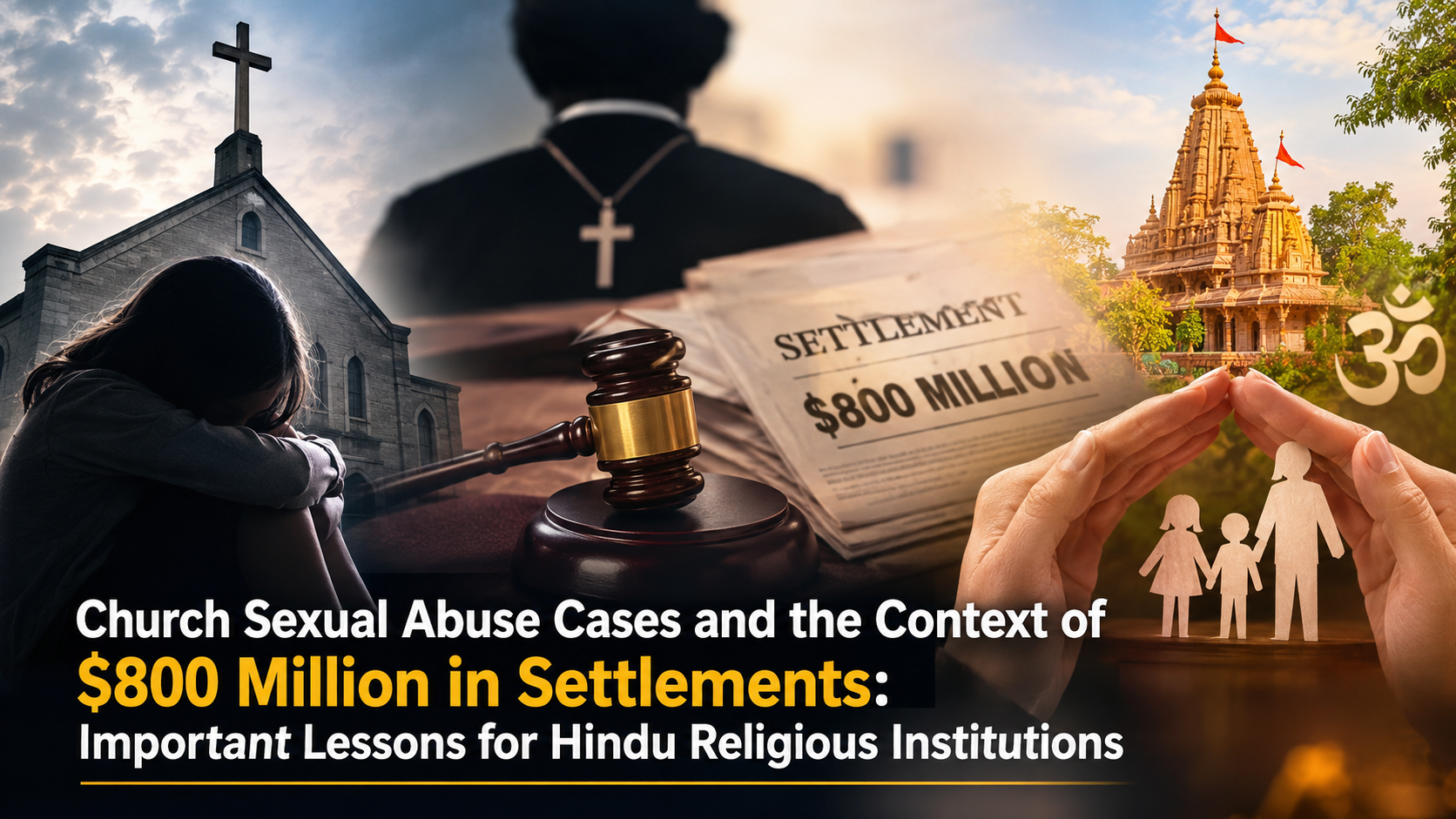
Reports of sexual abuse within church institutions, along with substantial financial settlements reportedly reaching hundreds of millions of dollars, raise serious questions about institutional accountability, transparency, and the protection of victims. These incidents should not be viewed merely as problems within one religious community. They offer important lessons for every religious institution, including Hindu organizations, temples, monasteries, ashrams, and other faith-based establishments.
1. Religious Authority Must Never Be Used to Exploit Vulnerable People
Religious leaders are often respected and trusted by their communities. Their positions can give them considerable moral and social influence. Unfortunately, that influence can also be abused.
Sexual abuse committed by religious leaders is particularly damaging because victims may find it difficult to speak out against someone whom their families and communities deeply respect. In some situations, victims may fear being disbelieved, blamed, threatened, or excluded from their religious communities.
No religious title, spiritual position, or institutional authority should place anyone above the law. Religious leadership must be accompanied by responsibility, ethical conduct, and respect for human dignity.
2. Institutional Reputation Must Never Be More Important Than Victims’ Rights
One of the most serious lessons from abuse scandals involving religious institutions is the danger of protecting an organization’s reputation at the expense of victims.
When allegations are concealed, complaints are ignored, or accused individuals are transferred without proper investigation, institutions can expose more people to harm. Such practices undermine public trust and may allow abuse to continue.
Religious organizations must understand that protecting victims is more important than protecting institutional image. Transparency and accountability are essential to restoring public confidence.
3. Compensation Cannot Replace Justice
The reported settlements amounting to approximately $800 million demonstrate the potentially enormous financial and social consequences of institutional failures.
Financial compensation may help victims address some of the harm they have experienced. However, money alone cannot erase trauma, restore lost childhoods, or fully repair the damage caused by sexual abuse.
True justice requires more than financial settlements. It requires:
- Proper investigation of allegations.
- Legal accountability for perpetrators.
- Responsibility from institutions that failed to protect victims.
- Appropriate support and compensation for survivors.
- Measures to prevent similar incidents in the future.
Victims must be treated with dignity, and their voices must be heard throughout the process.
4. Hindu Religious Institutions Must Learn from These Incidents
These cases should encourage Hindu religious institutions to examine their own practices and safeguarding systems.
Temples, monasteries, ashrams, religious schools, and other institutions should not assume that abuse cannot happen within their communities. No religious tradition is automatically protected from misconduct simply because it teaches morality and spirituality.
Hindu institutions should establish clear policies to protect children, women, and other vulnerable individuals. Religious leaders, teachers, priests, and volunteers should be subject to appropriate standards of conduct and accountability.
Institutions should also establish safe and confidential complaint mechanisms so that victims can report misconduct without fear of retaliation or social pressure.
5. Child Protection and Safeguarding Must Be a Priority
Children are among the most vulnerable members of any religious community. Many attend religious classes, camps, schools, and other activities under the supervision of adults whom their families trust.
Religious institutions should therefore introduce practical safeguarding measures, including:
- Background checks and appropriate screening of people working with children.
- Clear rules governing adult-child interactions.
- Adequate supervision during religious activities and residential programs.
- Training for religious leaders, teachers, and volunteers on recognizing and preventing abuse.
- Confidential reporting mechanisms for children and families.
- Immediate referral of credible allegations to the appropriate authorities.
These measures should be implemented consistently rather than existing only as written policies.
6. Religious Freedom Must Go Together with Legal Responsibility
Every religious community has the right to practice its faith and operate its religious institutions within the law. However, religious freedom must never be interpreted as freedom from legal accountability.
No institution should use religion, tradition, spiritual authority, or community influence to obstruct investigations or silence victims.
The law must apply equally to everyone, regardless of religious identity, institutional influence, or social status. Crimes should be investigated through lawful procedures, and allegations should be handled fairly and responsibly.
7. Transparency and Independent Investigation Are Essential
When serious allegations emerge, institutions should not rely solely on internal inquiries that may be influenced by conflicts of interest.
Independent investigations, cooperation with law enforcement, proper documentation, and transparent procedures are important safeguards. Institutions should also avoid making public statements that expose victims to further humiliation or intimidation.
A responsible religious organization should welcome accountability rather than fear it.
8. A Lesson for All Religious Communities in Nepal
Nepal is a country of diverse religious traditions, including Hinduism, Buddhism, Christianity, Islam, and other faiths. Religious institutions play important roles in education, social welfare, cultural life, and community development.
However, every institution must recognize that religious identity does not guarantee ethical behavior. Abuse, exploitation, and misconduct can occur wherever power is concentrated and accountability is weak.
The reported church abuse settlements should therefore serve as a warning and an opportunity for reflection—not as a reason to attack an entire religious community. Hindu institutions, Christian churches, Buddhist monasteries, Islamic organizations, and all other religious bodies should adopt strong safeguarding practices and demonstrate their commitment to justice.
The objective should not be to use the failures of one religious institution to condemn another. Rather, the objective should be to ensure that no child, woman, or vulnerable person suffers abuse under the protection or authority of any religious organization.
Conclusion: Human Dignity Must Come Before Institutional Reputation
The wider lesson from sexual abuse scandals involving religious institutions is that faith must be accompanied by integrity, transparency, and accountability. Religious organizations cannot claim moral authority while ignoring the suffering of victims or protecting individuals accused of serious misconduct.
Hindu religious institutions should take these incidents as an opportunity to strengthen their safeguarding policies, improve institutional transparency, and ensure that religious leaders are held to appropriate standards of conduct. The same responsibility applies to every religious community.
Ultimately, victims are more important than religious institutions, justice is more important than reputation, and human dignity is more important than religious identity.
Editorial note: The figure of approximately US$800 million is referenced in the source video’s title. Without independently confirming the country, institution, court proceedings, settlement records, and number of victims involved, this figure should be treated as a reported claim rather than an independently verified total.

Socioligist, Communication Expert, Certified Mediator, Certified Community Legal Document Assistant, Coach, Writer, Translator cum Interpreter, YouTuber, Master Teacher of some biblical training, Content Creator.
Contact for above services and consultation:
thomasbogaty@gmail.com
Watsapp: +977-9813249433
CHARGES AS PER THE SERVICE


