Introduction
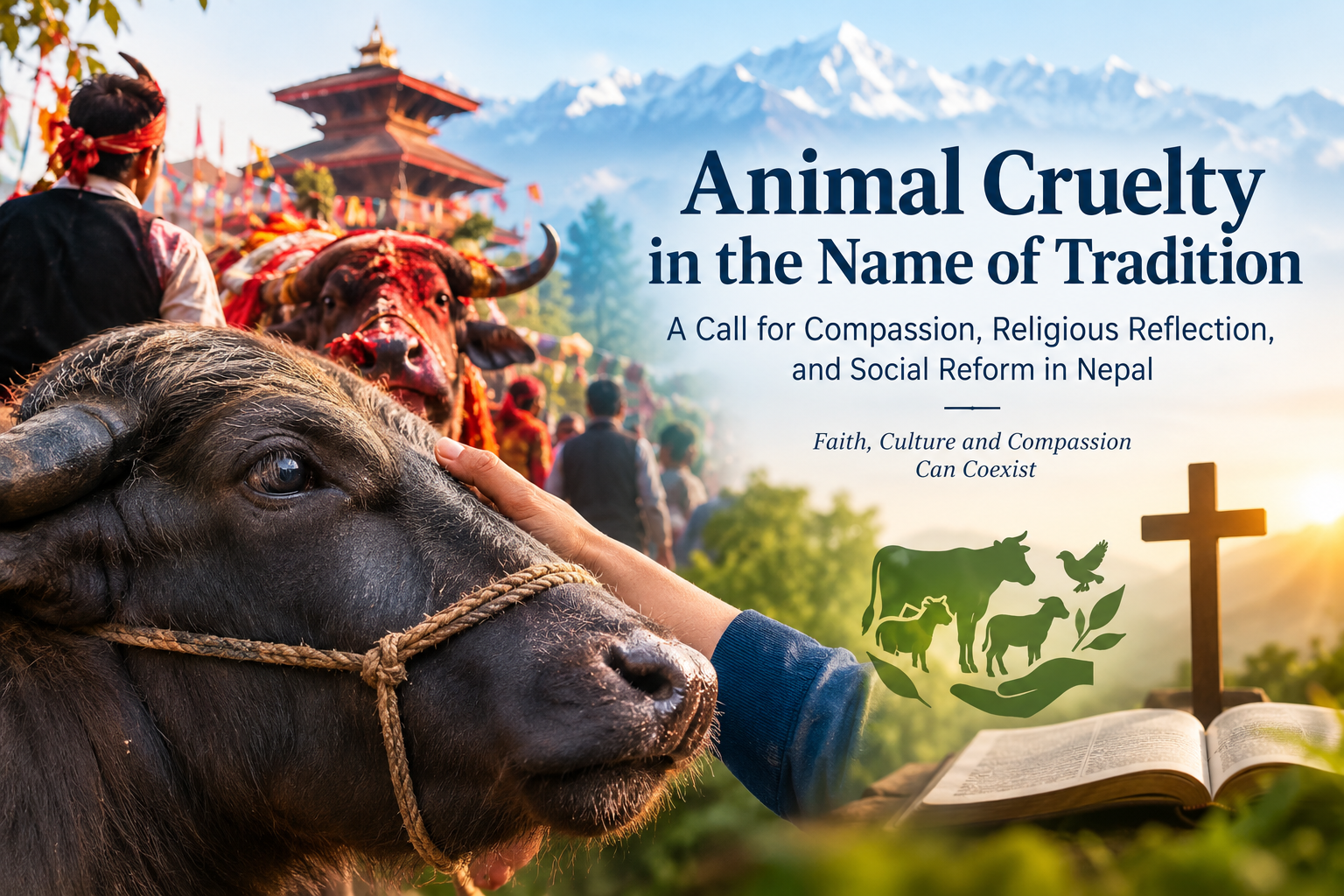
Festivals are meant to bring people together, strengthen cultural identity, and express religious devotion. However, when celebrations involve the deliberate infliction of unnecessary suffering on animals, society must pause and reconsider whether such practices are consistent with compassion, human dignity, and the values that religions seek to uphold.
A recent YouTube discussion raises an important issue concerning the treatment of animals during Dashain in Nepal. The speaker criticizes the practice of chasing, frightening, beating, and repeatedly attacking animals before killing them. He argues that such conduct should not be defended merely because it has been practiced in the name of tradition.
The discussion calls on Nepali society to distinguish between meaningful cultural heritage and harmful customs that require reform. It also examines the issue through the perspectives of Hindu religious values, Christian biblical teachings, and the broader responsibility of human beings toward animals and the natural world.
When Tradition Becomes a Question of Conscience
Nepal has a rich cultural and religious heritage, and Dashain holds significant importance for many Hindu communities. Animal sacrifice is part of certain religious observances, but practices differ across communities and locations.
The central concern raised in the video is not simply the existence of religious rituals. Rather, it is the deliberate torment of animals before their deaths.
The speaker describes reports and videos showing buffaloes, young buffaloes, and other animals being chased from one place to another, frightened by crowds, struck with weapons or stones, and subjected to physical abuse before being killed. He argues that such conduct is cruel and should not be justified as a necessary expression of religious faith.
A tradition’s age does not automatically make every aspect of it morally acceptable. Societies continually reassess inherited customs in light of changing understandings of justice, compassion, and responsibility. Practices such as child marriage and other forms of harmful social conduct have also been challenged and reformed over time.
The same principle can be applied to animal welfare. Cultural traditions can be respected while harmful elements are reconsidered and changed.
The essential question is straightforward: Can a religious festival be celebrated without deliberately causing an animal prolonged fear, pain, and distress?
A Hindu Voice Calling for Reform
One notable aspect of the video is its reference to a Hindu individual, identified by the speaker as Nirdosh Nitaya Das, who has expressed opposition to the cruel treatment of animals during Dashain.
The speaker presents this intervention as an important reminder that criticism of animal cruelty does not necessarily come from outside a religious tradition. People within a faith can also question practices they believe contradict its deeper moral and spiritual principles.
The video attributes to this Hindu perspective the argument that Sanatan Dharma should be understood as a tradition emphasizing love, friendship, and compassion. According to the discussion, practices that inflict unnecessary suffering on animals risk damaging the public perception of the religion itself.
The speaker also questions whether the practice of chasing and tormenting animals can be adequately justified by appealing to Hindu scriptures, particularly the Vedas and Upanishads. He suggests that those defending such practices should examine their religious and textual foundations carefully.
These are theological arguments presented in the video, rather than the results of a comprehensive examination of Hindu scripture. Hindu traditions contain diverse interpretations of sacrifice, ritual, nonviolence, and duty. A balanced discussion should acknowledge this diversity while taking animal suffering seriously.
Nevertheless, the broader moral challenge remains relevant: religious traditions should be open to reflection when a practice causes avoidable suffering.
Animal Cruelty and Nepal’s International Image
The video also connects animal cruelty with Nepal’s image before the international community.
In the age of social media, videos of public events can reach audiences far beyond the communities in which they occur. Images showing animals being chased, beaten, and frightened before being killed may provoke concern among viewers who regard animal welfare as an important ethical responsibility.
Such footage can influence how people perceive a society’s cultural practices. It can also overshadow the positive aspects of a festival, including family reunions, hospitality, generosity, and religious devotion.
The speaker argues that Nepalis should be mindful of how their actions are represented internationally. However, the purpose of reform should not be limited to protecting the country’s reputation. The more fundamental reason is the prevention of unnecessary suffering.
An action does not become wrong only when it is recorded and shared online. Nor does it become acceptable simply because it occurs privately or within a traditional setting.
The dignity of a cultural tradition is better protected when its participants demonstrate compassion, responsibility, and respect for living creatures.
Can Natural Disasters Be Connected to Human Sin?
Another issue raised in the video concerns the relationship between human conduct, environmental destruction, and natural disasters.
The speaker reads a social media post reflecting on floods, landslides, and other disasters in Nepal. The post asks whether humanity’s exploitation of nature and mistreatment of innocent living creatures should prompt deeper moral reflection.
It refers to disasters in places such as Rasuwa and Dhading and encourages people to examine their relationship with the environment, animals, and fellow human beings.
This reflection raises an important ethical question: How responsibly are we treating the world entrusted to our care?
Deforestation, environmental degradation, unsafe development, and the destruction of natural habitats can increase certain disaster risks. Human activities may therefore contribute to the severity of some floods and landslides.
However, it would be inaccurate to declare that a particular flood or landslide occurred because a community committed a particular sin. Natural disasters have complex geological, meteorological, environmental, and human factors. Their causes must be investigated using reliable evidence.
The video’s more defensible moral insight is that disasters can encourage reflection on our responsibilities toward nature and other living beings, without assuming that victims are being punished for wrongdoing.
Compassion for animals and concern for disaster victims can coexist with scientific explanations of natural hazards. Neither requires us to blame those who suffer.
What Does the Bible Teach About Animals?
A substantial portion of the video examines animal welfare through Christian scripture. The speaker argues that Christians should not participate in the deliberate torment of animals simply because a practice is associated with a cultural festival.
Several biblical passages are cited to support this position.
1. Proverbs 12:10 — The Righteous Care for Animals
Proverbs 12:10 teaches that a righteous person cares for the life of an animal, while the compassion of the wicked is described as cruel.
This verse offers a direct moral challenge to people who claim to value righteousness while disregarding the suffering of animals under their control.
Caring for animals involves more than feeding or owning them. It also requires consideration of their pain, fear, safety, and basic welfare.
From this perspective, deliberately chasing an animal, striking it repeatedly, and prolonging its suffering raises serious questions about the meaning of compassion.
2. Ecclesiastes 3:19 — Human Beings and Animals Share Mortality
Ecclesiastes 3:19 reflects on the shared fate of human beings and animals, observing that both die and that both possess the breath of life.
The passage appears within a broader reflection on mortality and the limitations of human understanding. It does not erase every distinction between humans and animals, but it reminds readers that human beings are also mortal creatures.
The video uses this passage to encourage humility and to challenge the assumption that human superiority gives people unlimited moral permission to mistreat other living beings.
3. Exodus 23:5 — Help an Animal in Distress
Exodus 23:5 instructs people to help when they see the donkey of someone they dislike struggling under its burden.
The principle is striking because the duty to help is not restricted to an animal belonging to a friend. Even an animal associated with an adversary should not be abandoned to suffering.
This teaching places compassion above personal hostility. Applied more broadly, it challenges the idea that concern for an animal should depend solely on its owner, usefulness, or religious significance.
4. Deuteronomy 25:4 — Do Not Muzzle an Ox While It Is Working
Deuteronomy 25:4 commands that an ox should not be muzzled while it is threshing grain.
The verse recognizes an obligation toward an animal even while it performs work that benefits human beings.
The video invokes this principle to argue that animals should not be treated merely as instruments for human purposes. Their welfare matters, even when people depend on them.
5. Proverbs 27:23 — Know the Condition of Your Flocks
Proverbs 27:23 encourages people to know the condition of their flocks and pay careful attention to their herds.
This instruction emphasizes attentive responsibility. Caring for animals requires awareness of their condition and needs rather than indifference to their suffering.
6. Psalm 145:9 — God’s Goodness Extends to All His Works
Psalm 145:9 declares that the Lord is good to all and that His compassion extends over all He has made.
The verse presents divine goodness as extending beyond human beings alone. It invites believers to consider how their own conduct should reflect the compassion they attribute to God.
7. Matthew 6:26 — The Birds of the Air
In Matthew 6:26, Jesus directs attention to the birds of the air, which do not sow, reap, or store food in barns, yet are fed by the heavenly Father.
Jesus uses this illustration to teach about trust in God and human worth. The speaker also draws attention to the passage as a reminder that animals have a place in God’s creation and should not be regarded with indifference.
8. Genesis 1:28 — Dominion and Responsibility
Genesis 1:28 describes God’s instruction to humanity to exercise dominion over the earth and its living creatures.
The video argues that dominion should not be interpreted as permission for unrestricted cruelty. Instead, the authority given to human beings should be exercised responsibly.
Although Christians differ in how they interpret the implications of this passage for environmental ethics, the principle of responsible stewardship offers a meaningful framework for considering animal welfare.
Taken together, these passages support the speaker’s central appeal: Christians should take seriously the biblical emphasis on care, responsibility, and compassion toward animals.
A Challenge to Christians Participating in Cruel Practices
The video also addresses Christians who participate in festivals or activities in which animals are deliberately tormented.
The speaker urges Christian viewers to examine their own conduct rather than assume that animal cruelty is exclusively a problem within another religious community.
This is an important element of the discussion. Ethical principles lose credibility when people demand compassion from others but fail to practice it themselves.
Christians who believe that animals are part of God’s creation should consider whether their actions demonstrate responsible stewardship. Participation in a cultural celebration does not remove the responsibility to distinguish between harmless festivities and conduct that causes unnecessary suffering.
The same standard should apply to people of every religious background, including Hindus, Muslims, Buddhists, Christians, and those who follow no religion.
Animal welfare is not a responsibility that belongs to one religious community alone. It is a shared ethical concern.
Questions About Selective Advocacy
The video also raises questions about the consistency of public advocacy against animal cruelty. It mentions Ashika Tamang and her reported opposition to goat sacrifice at Hanuman Dhoka during Dashain.
The speaker questions whether attention to one form of sacrifice is accompanied by comparable concern about reports of animals being chased and tormented in other locations.
This criticism should be understood as the speaker’s opinion. The transcript alone does not establish the motives of the individuals mentioned or provide sufficient evidence to determine whether their advocacy is selective.
Nevertheless, the underlying question deserves consideration: Should opposition to animal cruelty be consistent across communities, regions, and religious traditions?
If the concern is the prevention of suffering, the standard should not change according to the identity of the animal’s owner or the religion associated with a particular ritual.
Public figures and campaigners can strengthen their credibility by applying clear, consistent principles and supporting their claims with verifiable information.
Reforming Harmful Customs Without Rejecting Cultural Identity
A central message of the video is that societies must remain willing to reform traditions when they cause harm.
Cultural heritage is not necessarily weakened by reform. In many circumstances, thoughtful change allows a tradition to preserve its meaningful elements while abandoning practices that conflict with contemporary understandings of welfare and responsibility.
Dashain can remain a time of family gatherings, blessings, generosity, community solidarity, and religious observance without requiring people to tolerate the deliberate torment of animals.
Communities can discuss humane alternatives, improve animal-handling practices, strengthen public awareness, and encourage religious leaders to address animal welfare in their teachings.
Schools, families, local governments, community organizations, and religious institutions can contribute to this effort. Educational campaigns can help children develop empathy toward animals, while community discussions can create opportunities to examine difficult questions without unnecessary hostility.
Reform is most constructive when it is grounded in accurate information, respect for people, and a clear commitment to reducing suffering.
The objective should not be to humiliate a religious community or portray an entire culture as cruel. It should be to encourage every community to examine harmful practices honestly and identify better ways forward.
Conclusion: Let Compassion Become Part of Our Tradition
The YouTube discussion delivers a strong appeal for a more compassionate approach to animals during Dashain and other cultural or religious celebrations.
Its message extends beyond the question of animal sacrifice. It challenges people to examine the relationship between tradition and conscience, religious identity and ethical responsibility, and human authority and care for the natural world.
The biblical passages discussed in the video encourage Christians to care for animals, while the Hindu perspective presented by the speaker illustrates that calls for reform can also emerge from within the traditions being questioned.
These perspectives need not become sources of religious conflict. Instead, they can contribute to a shared conversation about compassion and responsibility.
At the same time, claims about the religious origins of particular practices, the motives of public figures, and the causes of natural disasters should be examined carefully and supported by reliable evidence.
Nepal’s cultural diversity is a valuable part of its identity. Protecting that heritage does not require preserving every inherited practice unchanged. A society can honour its history while rejecting unnecessary cruelty.
The challenge, therefore, is not simply to ask whether a practice is traditional. It is to ask whether it can be carried out with compassion, whether the suffering it causes is necessary, and whether a more humane alternative is possible.
If we want future generations to inherit a society that values both cultural heritage and moral responsibility, we must be willing to reform practices that inflict avoidable suffering.
A festival should be remembered for its devotion, generosity, and humanity—not for the fear and pain inflicted on helpless creatures. Compassion should not be an exception to tradition; it should be one of the principles by which tradition is judged.

Socioligist, Communication Expert, Certified Mediator, Certified Community Legal Document Assistant, Coach, Writer, Translator cum Interpreter, YouTuber, Master Teacher of some biblical training, Content Creator.
Contact for above services and consultation:
thomasbogaty@gmail.com
Watsapp: +977-9813249433
CHARGES AS PER THE SERVICE


