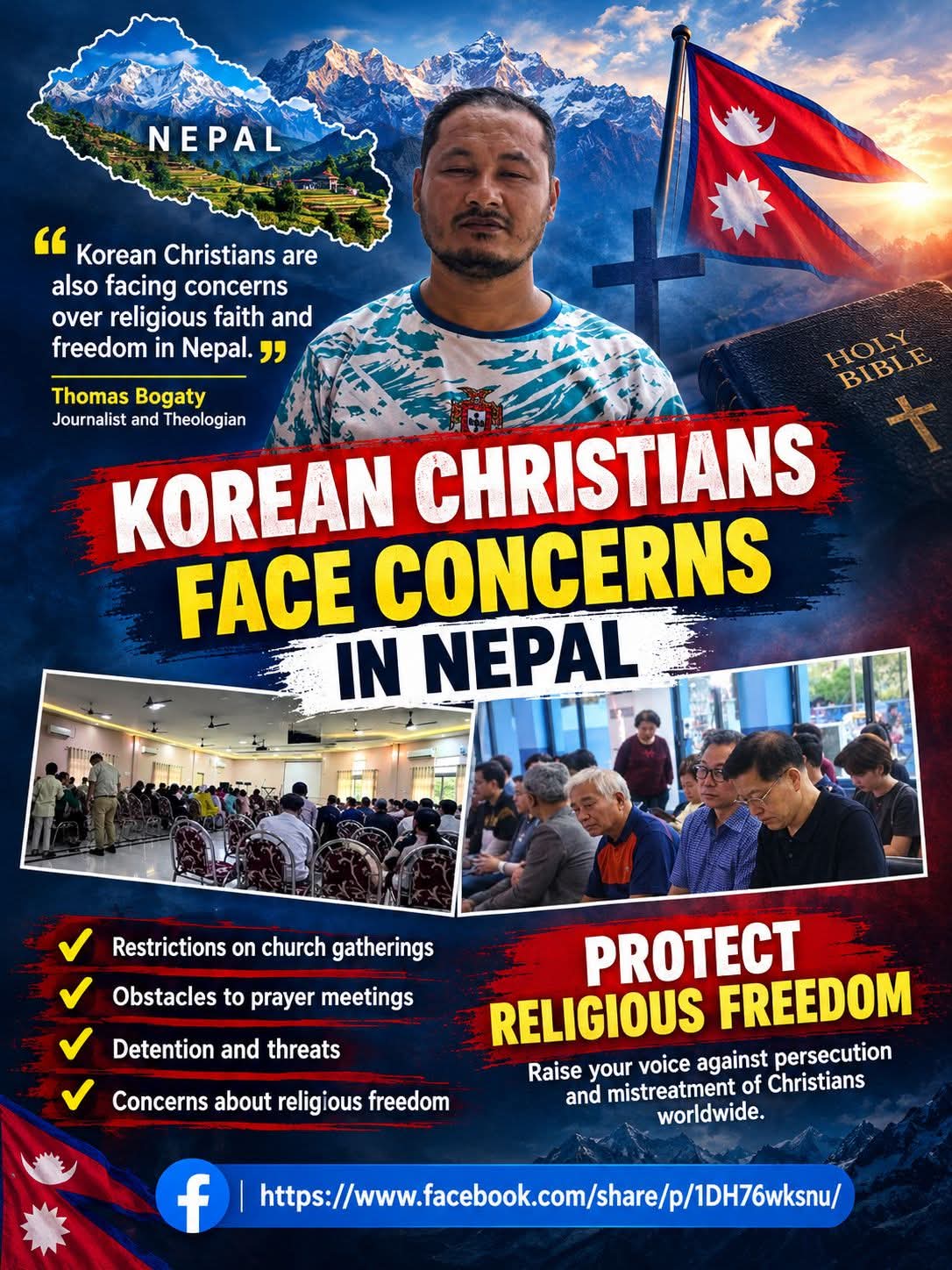
Regarding the matter presented, information was received that some Korean citizens had entered Nepal on tourist visas and participated in religious activities, including a graduation ceremony and religious programs organized by an educational institution named Nepal New Covenant College (NNCC), located in the “Sundar Danda” area, Malati Marg, Ward No. 9, Sundarharaicha Municipality, Morang District.
Upon investigation into the matter, it was found that the Korean citizens concerned had engaged in activities contrary to Sub-rule (2) of Rule 20 of the Immigration Regulations, 2051 (1994), by entering Nepal on tourist visas and engaging in activities related to religious education, training, instruction, and religious propagation.
Accordingly, 24 South Korean citizens were directed to appear before the Department for necessary action pursuant to Sub-clauses (2) and (3) of Section 4.6 of the Foreign Citizen Monitoring Directive, 2075 (2018).
1. Provisions under the Immigration Act, 2049 (1992)
– Section 4: Conditions to be observed by foreigners
Sub-section (1) provides that the conditions to be observed by foreigners residing in Nepal shall be as prescribed.
– Section 9, Sub-section (1)
It provides that after an immigration officer completes an investigation into an offence concerning a foreigner under this Act and submits a report to the Director General, the Director General may, on the basis of that report, regularize matters as prescribed where necessary and, with the approval of the Government of Nepal, deport the foreigner from Nepal, specifying or not specifying a period during which the foreigner may not re-enter Nepal.
– Section 10: Penalties
Sub-section (4) provides that if anyone commits an act contrary to this Act or the Rules made under it, the Director General may recover the amount determined to be payable and impose a fine of up to NPR 50,000.
2. Provisions under the Immigration Regulations, 2051 (1994)
– Rule 20, Sub-rule (1)
It provides that a foreigner who obtains a visa as a tourist or as a family member under these Regulations shall not be permitted to work in any industry, trade, business, or institution in Nepal, whether for remuneration or without remuneration.
Rule 20, Sub-rule (2) further provides that a foreigner who obtains a visa under these Regulations shall not engage in any activity other than the purpose for which the visa was issued.
– Rule 6, Sub-rule (2)
It provides that a tourist visa shall be issued for a maximum period of five months in a year.
– Rule 41
It provides that every foreigner entering Nepal, staying in Nepal, undertaking a journey within Nepal, or departing from Nepal must comply with the provisions specified in the Immigration Act and the Immigration Regulations. These provisions establish the conduct and conditions that foreigners are required to observe.
3. Provisions under the Foreign Citizen Monitoring Directive, 2075 (2018)
– Section 4.6: Duties, responsibilities, and powers of the District Monitoring Committee
1. To monitor foreigners residing within the district.
2. To monitor whether foreign citizens residing within the district on Nepalese visas are carrying out activities consistent with the visas they have received.
For example, this includes foreigners engaging in commercial activities while holding tourist visas, or engaging in other activities while holding business visas.
The Constitution of Nepal guarantees every citizen the freedom to practice religion according to their faith, religion, and beliefs. Religious tolerance, mutual respect, and equal treatment of all religions are fundamental values of a democratic state.
We have taken serious note of reports that 24 Christian citizens from South Korea, who came to Nepal on tourist visas, were arrested by the police for attending churches, praying, and speaking about biblical teachings. If they were arrested solely because they attended church, prayed according to their religious faith, or read the Bible, this raises serious questions concerning religious freedom and equality before the law.
In Nepal, religious leaders, preachers, and followers of various religions, including Hinduism, Buddhism, and Islam, have traditionally visited from abroad, attended their respective places of worship, performed religious rituals and worship, and exchanged religious teachings. In this context, treating individuals associated with the Christian faith differently would contradict the principle of equality.
We wish to make it clear that if any foreign national is found to have violated the conditions of their visa, engaged in forced religious conversion, used inducements or coercion, or committed any act contrary to Nepal’s prevailing laws, an impartial investigation and appropriate legal action should follow in accordance with the law. However, arresting anyone solely on the basis of their religious faith, church attendance, or speaking about biblical teachings, without evidence of any such offense, is not justified. The nature of the complaint, the legal grounds for the arrests, and the actual circumstances of the incident must be made public.
In this regard, we call upon the Government of Nepal, the Ministry of Home Affairs, and the relevant security agencies to address the following demands:
1. Clarify the legal grounds for the arrests.
Clearly disclose the legal basis and specific alleged offenses for which the 24 South Korean citizens were arrested.
2. Ensure an impartial investigation and release where appropriate.
Conduct an impartial investigation into the incident and, if it is found that they have not violated any law, initiate the necessary procedures for their immediate release.
3. Apply equal legal standards to all religious groups.
Ensure that all foreign religious leaders, preachers, and followers visiting Nepal are subject to equal legal standards without discrimination based on religion.
4. Investigate allegations fairly without criminalizing religious faith.
If anyone is accused of forcing religious conversion or engaging in other unlawful activities, investigate the allegations impartially. However, a person’s religious faith itself must not be treated as a criminal offense.
5. Protect constitutional religious freedom and equality.
The Government of Nepal must safeguard constitutionally guaranteed religious freedom, the right to equality, and religious tolerance, ensuring equal respect and protection for followers of all religions.
Our demand is not to grant special privileges to any religion or place any religion above the law. We simply demand that people of all religions receive equal treatment under the law, equal justice, and equal respect.
If any foreign national violates the law, legal action should be taken in accordance with the law, regardless of their religion. However, if foreign nationals belonging to Hinduism, Buddhism, Islam, or other religions are permitted to worship, pray, and practice their religious teachings according to their faith, Christian citizens should not be treated differently. The law must apply equally to everyone and must not be enforced more harshly against only one religious group.
Nepal is a country of multiple religions, diverse cultures, and different traditions. The state also has a responsibility to preserve religious harmony in such a society. No person should be placed in a situation where they feel unsafe, humiliated, or discriminated against because of their religious faith.
Therefore, we strongly urge the Government of Nepal to make the facts of this incident public, ensure impartial justice, and take steps to prevent religious discrimination against people of any faith in the future.
Religious freedom is everyone’s right. Equality is everyone’s entitlement. Justice must be for all.
Note: The date 2083/06/23 B.S. corresponds to October 9, 2026. The translation preserves the press release’s allegations and demands as stated in the original; it does not independently verify the reported arrests or the circumstances of the incident.

Socioligist, Communication Expert, Certified Mediator, Certified Community Legal Document Assistant, Coach, Writer, Translator cum Interpreter, YouTuber, Master Teacher of some biblical training, Content Creator.
Contact for above services and consultation:
thomasbogaty@gmail.com
Watsapp: +977-9813249433
CHARGES AS PER THE SERVICE